


Select host trees
Choose declining but still structurally stable hardwoods such as sugar maple or beech as hosts, since this fungus depends on dead or weakened wood and establishes more reliably on stressed trees than on vigorous specimens.

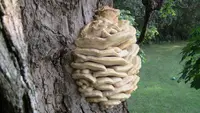
Northern tooth, Climacodon septentrionalis, is a bracket fungus rather than a traditional leafy plant. It forms large, overlapping shelves with pale, toothed undersides on dead or weakened hardwood trees, especially maple.
This species is native to temperate forests in North America and parts of Europe, where it plays a role in wood decay. It is not commonly cultivated and is better viewed as a wild woodland organism than a garden feature.
Those who wish to care for Northern Tooth in controlled conditions need to understand its requirement for consistently moist, decaying wood and cool, shaded environments, which makes home cultivation challenging.

Care Difficulty
Moderate Care

Light Preference
Shade

Water Requirements
Keep Soil Moist

Temperature Preference
Cool Climate

Hardiness Zone
3–8

Soil Texture
Loamy, Silty, Organic-rich

Soil pH
Acidic (5.5–6.5), Slightly acidic (6.5–7.0)

Soil Drainage
Moist but well-drained

Fertilization
Minimal (feed rarely)
Scan your plant to receive care tips personalized for your specific plant
Available on iOS and Android
This wood-decaying fungus prefers cool, shaded forest conditions rather than direct sun exposure.
Climacodon septentrionalis relies on consistent wood moisture rather than direct watering of the fruiting bodies.
This species develops best in cool to mild conditions typical of temperate forests.
Humidity is not a meaningful care factor for Climacodon septentrionalis in typical outdoor conditions.
This bracket fungus develops on decaying hardwood and does not need soil in the usual horticultural sense.
Climacodon septentrionalis is not well suited to standard container growing, since it is a wood-decaying fungus that relies on hardwood rather than potting media.
This wood-decaying fungus naturally feeds from host trees and usually needs no additional fertilizer in cultivation.
Pruning is generally not required for Climacodon septentrionalis, as it is a wood-rotting bracket fungus rather than a traditional garden plant.
Transplanting is rarely practical because this fungus is tightly associated with the internal wood and heart rot of mature hardwood trees.
Propagation of this species is specialized and usually left to natural spore spread in forest or woodland settings.
This temperate-zone fungus is naturally cold hardy and needs no specific winter care in outdoor conditions, making caring for Northern Tooth very low maintenance.

Plant Health Check
Not sure what's wrong with your plant? Check your plant's health inside the app.
This fungus forms large, fleshy brackets with dense downward-pointing spines or “teeth” on the underside, which greatly increase surface area for spore production and dispersal compared with a smooth pore surface.
It is a wood-decay fungus that mainly colonizes living or recently dead hardwood trees such as sugar maple and basswood, causing a white rot that breaks down both lignin and cellulose and can contribute to structural weakness in mature trees.
Fruiting bodies typically appear in late summer to autumn in temperate regions, often persisting into cool, moist weather when many other bracket fungi have already deteriorated.

Mature fruiting bodies of this species can exude abundant clear to milky droplets in humid conditions, a process called guttation that results from excess internal moisture and dissolved metabolites being forced out through specialized tissues at the surface.
This fungus develops seasonally rather than continuously. Fruiting bodies typically appear and enlarge over several weeks in late summer to early fall, then persist while slowly toughening. Growth rate depends on host tree condition, moisture, and temperature.
Keep your plants happy and healthy with plant identification, disease detection, and easy care guidance.

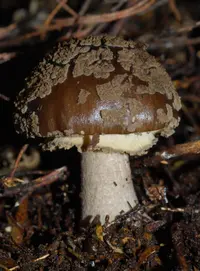
Southern Beech Amanita
Amanita nothofagi
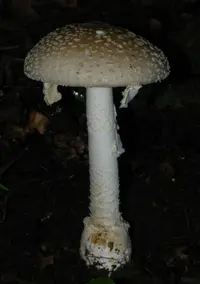
Small Funnel-Veil Amanita
Amanita multisquamosa
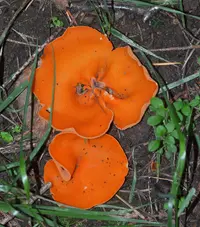
Orange peel fungus
Aleuria aurantia
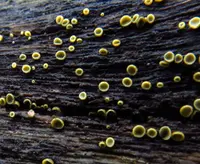
Chlorosplenium chlora
Chlorosplenium chlora
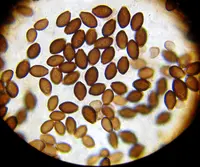
Panaeolus olivaceus
Panaeolus olivaceus
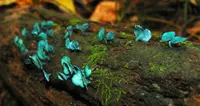
Green Wood Cup
Chlorociboria aeruginascens
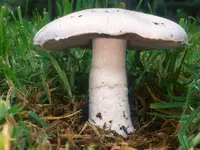
Meadow Mushroom
Agaricus campestris
Austropaxillus infundibuliformis
Austropaxillus infundibuliformis