Encourage Compact Clumps
Rotate the pot 90° every 2–3 weeks during active growth to keep stems evenly lit and encourage a symmetrical, compact clump instead of leaning or one‑sided growth.

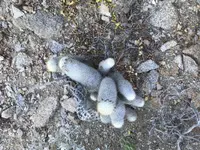
Cochemiea albicans is a small, clustering cactus native to arid regions of Mexico, where it grows on rocky slopes and well-drained hillsides. It forms tight clumps of cylindrical stems covered in pale, bristly spines that can give the plant a whitish appearance.
In spring, it often produces tubular red or orange flowers near the stem tips, attracting pollinators in its native habitat. Its slow growth, drought tolerance, and compact size make it suitable for containers and rock gardens.
This species prefers bright light, low to moderate watering, and gritty, fast-draining soil. These traits make it relatively straightforward to care for Cochemiea albicans if overwatering is avoided.

Care Difficulty
Moderate Care

Light Preference
Full Sun

Water Requirements
Low Water

Temperature Preference
Warm Climate

Hardiness Zone
9–11

Soil Texture
Sandy, Rocky, Loamy

Soil pH
Slightly acidic (6.5–7.0), Neutral (7.0)

Soil Drainage
Well-drained

Fertilization
Minimal (feed rarely)
Scan your plant to receive care tips personalized for your specific plant
Available on iOS and Android
This small desert cactus needs strong, direct light to stay compact and flower well.
This drought-adapted cactus prefers thorough but infrequent watering with fast-draining soil.
This species prefers warm, dry conditions and is sensitive to prolonged cold and frost.
This cactus prefers dry air and rarely needs humidity adjustment indoors.
This species needs a very fast-draining, mineral-rich substrate to prevent root rot.
This species is well suited to container growing in bright, dry locations.
Feeding should stay light, as Cochemiea albicans is adapted to nutrient-poor, rocky soils.
Pruning needs are minimal and mostly focused on hygiene for Cochemiea albicans.
Container-grown plants benefit from careful repotting that disturbs the roots as little as possible.
Multiplying this cactus is typically done by offsets or seeds under warm, bright, and dry conditions.
Cold management is important because this cactus dislikes prolonged freezing, especially in wet soil.

Plant Health Check
Not sure what's wrong with your plant? Check your plant's health inside the app.
This species has distinctive white to yellowish spines coated in a waxy substance that reflects intense desert sunlight and helps reduce water loss from the stem surface.
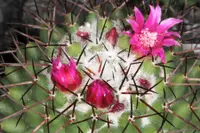
It produces narrow, tubular red flowers that are oriented outward from the stem, an adaptation that suits hummingbird pollination in its native Mexican habitat.
In nature it often grows in tight clusters on rocky limestone slopes and cliffs, where its compact growth and strong root system help anchor it in shallow, fast-draining crevices.

Cochemiea albicans was long treated within the large genus Mammillaria, and its reclassification into Cochemiea reflects modern molecular studies showing that the old Mammillaria concept contained several genetically distinct lineages.
This species generally performs best outdoors in bright, arid conditions similar to its native habitat. It can adapt to containers indoors if provided with high light, excellent drainage, and careful watering following basic Cochemiea albicans care instructions.
Keep your plants happy and healthy with plant identification, disease detection, and easy care guidance.