Cluster management
Periodically thin out overcrowded offsets with sterile tools so that air can move between stems, which lowers the risk of rot in dense clumps as the plant matures.

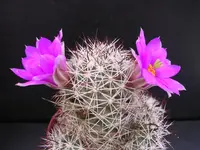
Cochemiea schumannii is a small, clustering cactus known for its dense spines and bright tubular flowers, usually red or orange, along the stems. It forms tight clumps of upright cylindrical stems that can create a compact mound over time.
This species is native to arid regions of Mexico, where it grows on rocky slopes with strong light and sharp drainage. Its drought tolerance and slow growth make it relatively easy to manage if watering is conservative. Understanding how to care for Cochemiea schumannii mainly involves providing bright light, very well-draining soil, and minimal moisture.

Care Difficulty
Moderate Care

Light Preference
Full Sun

Water Requirements
Low Water

Temperature Preference
Tropical / Frost Sensitive

Hardiness Zone
10–11

Soil Texture
Sandy, Rocky, Loamy

Soil pH
Slightly acidic (6.5–7.0), Neutral (7.0)

Soil Drainage
Well-drained

Fertilization
Minimal (feed rarely)
Scan your plant to receive care tips personalized for your specific plant
Available on iOS and Android
This desert cactus needs strong light to stay compact and flower reliably.
This species is highly drought-tolerant and must dry well between waterings.
This cactus prefers warm, dry conditions with strong seasonal cooling but no hard frost.
This cactus thrives in dry indoor air and rarely needs extra humidity attention.
Cochemiea schumannii needs a very fast-draining, mineral-rich substrate to prevent root rot.
This species is well suited to container culture, indoors or outdoors, if drainage and stability are managed carefully.
This desert cactus stays compact and healthy with very light feeding during the warm growing season.
Pruning needs for Cochemiea schumannii are minimal and focus on hygiene rather than shaping.
This cactus grows slowly and only needs occasional repotting or transplanting in well-drained, gritty soil.
Propagation of Cochemiea schumannii is usually done from offsets or seeds under warm, bright, and dry-stable conditions.
This species is not frost hardy and needs cool, dry, and bright conditions indoors or under shelter in winter.

Plant Health Check
Not sure what's wrong with your plant? Check your plant's health inside the app.
This species is naturally restricted to rocky coastal and desert slopes of the southern Baja California Peninsula in Mexico, where it grows on mineral-poor, well-drained substrates exposed to full sun.
Its tubular red flowers emerge laterally from the stem and often end in a stiff, bristle-like tip that is interpreted as a modified extension of the floral tube, a distinctive feature within its genus.
The bright red, elongated flowers are adapted for pollination by hummingbirds, which can easily access the nectar while transferring pollen between plants in its arid native range.

This species was long known under the name Mammillaria schumannii and has been reclassified into the genus Cochemiea based on modern taxonomic work that combines detailed morphological study with molecular (DNA-based) evidence.
Lack of flowers usually comes from insufficient light, too much water in winter, or a pot that is overly rich and moist. Provide a cool, very bright, drier winter rest so buds can form the following season.
Keep your plants happy and healthy with plant identification, disease detection, and easy care guidance.