


Mounting strategy
Consider mounting plants on cork or hardwood slabs with a thin moss layer to mimic their natural epiphytic habit and improve root aeration, especially in high-humidity grow spaces.

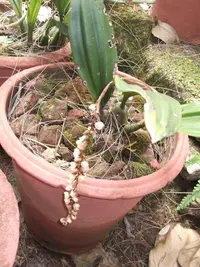
Coelogyne pallida, often called pale Pholidota, is an epiphytic orchid that usually grows on trees or rocks in the Himalayas and parts of Southeast Asia. It forms slender, arching pseudobulbs with narrow leaves and produces graceful, pale cream to greenish flowers along a drooping spike.
The plant prefers cool to intermediate conditions and steady humidity, which reflects its origin in misty, montane forests. Its moderate growth rate and need for stable moisture make it somewhat demanding, but not impossible, for indoor growers. Understanding how to care for Pale Pholidota starts with providing soft light, good air movement, and a free-draining, airy orchid substrate.

Care Difficulty
Moderate Care

Light Preference
Bright Indirect Light

Water Requirements
Keep Soil Moist

Temperature Preference
Tropical / Frost Sensitive

Hardiness Zone
Unknown

Soil Texture
Peaty, Organic-rich

Soil pH
Acidic (5.5–6.5)

Soil Drainage
Moist but well-drained

Fertilization
Moderate (every 2–4 weeks)
Scan your plant to receive care tips personalized for your specific plant
Available on iOS and Android
This orchid prefers bright, filtered light that mimics high, lightly shaded forest canopies.
This species prefers evenly moist conditions during active growth but dislikes waterlogged roots.
This orchid grows best in intermediate to warm conditions with a mild temperature drop at night.
This orchid prefers consistently moist air and reacts quickly to dry indoor conditions.
Coelogyne pallida grows best in a loose, airy epiphytic mix rather than dense potting soil.
This species is well suited to container growing when the pot supports its spreading, pseudobulb-forming habit.
This orchid benefits from light, consistent feeding during active growth for healthy pseudobulbs and flowering.
Pruning needs for Coelogyne pallida are minimal and focus on hygiene rather than shaping.
This sympodial orchid prefers infrequent but timely repotting to maintain a fresh, airy medium.
Division is the standard method for increasing Coelogyne pallida plants in home collections.
This orchid is not frost hardy and needs cool to mild, frost-free winter conditions.

Plant Health Check
Not sure what's wrong with your plant? Check your plant's health inside the app.
This species is native to the eastern Himalayas and surrounding ranges, where it grows as an epiphyte or lithophyte in cool to intermediate montane forests, often between roughly 1,000–2,000 m in elevation.
It usually flowers in late winter to spring, producing arching inflorescences with several creamy to yellowish flowers that emit a noticeable, sweet fragrance, especially in the morning hours.
The flowers have a 3-lobed labellum (lip) marked with yellow to orange keels and ridges, a visual guide that helps direct visiting pollinators toward the reproductive structures.

In its native range, this orchid often grows on mossy tree trunks or rocks in bright, airy forest edges, where frequent mists and strong day–night temperature drops create the cool, humid microclimate that horticulturists try to replicate when growing Pale Pholidota.
Lack of blooms usually comes from insufficient light, too-warm nights, or not enough temperature drop between day and night. Slightly cooler, drier rest after new growth matures often triggers spikes. Avoid frequent repotting and heavy nitrogen fertiliser.
Keep your plants happy and healthy with plant identification, disease detection, and easy care guidance.
