


Substrate rotation
Rotate or replace the underlying sclerotia or lentil-shaped tubers every 2–3 flushes to prevent nutrient exhaustion and reduce buildup of competing molds.

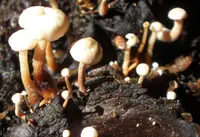
Lentil shanklet, Collybia tuberosa, is a small saprophytic fungus that grows on decaying mushrooms rather than in soil. It forms thin, pale stems with tiny caps emerging from firm, lentil-shaped sclerotia at the base. These structures store nutrients and help the fungus survive between fruiting periods.
In nature, it is found in temperate forests, often appearing on old, rotting Russula or Lactarius mushrooms. It is not a typical houseplant, and attempts to care for Lentil Shanklet at home are challenging because it depends on specific decaying hosts and consistently cool, moist conditions.
Collybia tuberosa is best appreciated in natural or semi-natural woodland settings rather than in traditional garden beds or containers.

Care Difficulty
Hard Care

Light Preference
Shade

Water Requirements
Keep Soil Moist

Temperature Preference
Cool Climate

Hardiness Zone
Unknown

Soil Texture
Organic-rich, Loamy

Soil pH
Acidic (5.5–6.5)

Soil Drainage
Moist but well-drained

Fertilization
Minimal (feed rarely)
Scan your plant to receive care tips personalized for your specific plant
Available on iOS and Android
Collybia tuberosa is a small saprobic fungus that prefers low light conditions similar to a shaded forest floor.
This fungus relies on consistently moist, not waterlogged, conditions around its decaying host material.
This species fruits best in cool to mild conditions typical of forest floors in temperate regions.
This fungus prefers consistently moist, high-humidity conditions around 70–90% to fruit well.
Collybia tuberosa fruits best on consistently moist, organic-rich substrate rather than typical garden soil.
This species can be grown in shallow containers that hold a moist, decaying organic substrate.
Collybia tuberosa is a saprophytic fungus that normally requires no added fertilizer when grown on suitable decaying organic material.
Pruning is not part of standard management for Collybia tuberosa, which naturally completes short-lived fruiting cycles on decaying substrates.
Transplanting Collybia tuberosa focuses on moving its colonized substrate rather than handling individual fruiting bodies.
Propagation of Collybia tuberosa relies on spreading its mycelium rather than typical plant methods such as cuttings or seed sowing.
Collybia tuberosa is naturally cold hardy in temperate climates and usually needs no special winter care when left in outdoor woodland conditions, which simplifies Collybia tuberosa care instructions for naturalized sites.

Plant Health Check
Not sure what's wrong with your plant? Check your plant's health inside the app.
This species typically fruits directly on the decaying remains of other mushrooms, especially russulas and lactarius, rather than on soil or wood. It acts as a saprotroph, decomposing the old fruiting bodies and helping recycle fungal organic matter in the forest floor.
Each slender stem arises from a small, hardened orange to reddish-brown nodule called a sclerotium, which is a compact mass of fungal tissue that stores nutrients. This sclerotium develops on the old host mushroom and allows the fungus to survive unfavorable conditions in a dormant state.
Fruit bodies often appear in cool, late-season conditions, frequently after the host mushrooms have already decayed. In some regions they can be found into autumn and early winter, taking advantage of the moist, cool microhabitat created by decomposing fungi.

Molecular studies have shown that this species, once grouped in the genus Collybia, is distinct enough to be placed in a separate genus, making its currently accepted name Stipitella tuberosa in many modern mycological treatments.
This small fungus is not considered a good edible species. It is usually described as inedible due to its tiny size and poor texture. It is not known to be dangerously toxic but should not be collected for food.
Keep your plants happy and healthy with plant identification, disease detection, and easy care guidance.

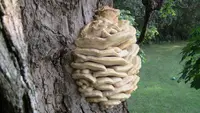
Northern Tooth
Climacodon septentrionalis
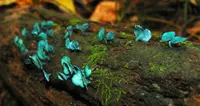
Green Wood Cup
Chlorociboria aeruginascens
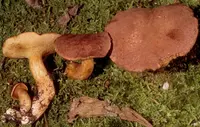
Bothia
Bothia castanella
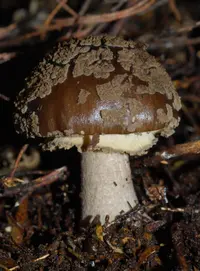
Southern Beech Amanita
Amanita nothofagi
Ceriporia excelsa
Ceriporia excelsa
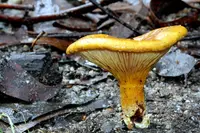
Austropaxillus infundibuliformis
Austropaxillus infundibuliformis
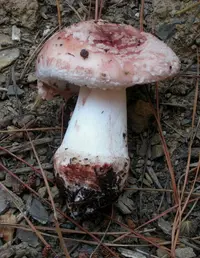
Blushing Bride Amanita
Amanita novinupta
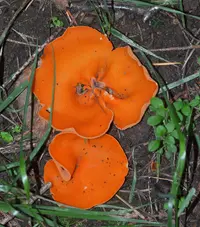
Orange peel fungus
Aleuria aurantia