


Rotate Hanging Pot
Rotate the hanging basket 90° every 1–2 weeks so all sides receive similar light, which keeps the plant evenly full instead of bald on the shaded side.

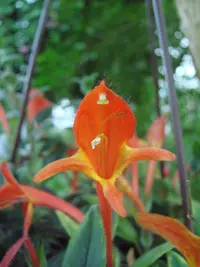
Columnea hirta, often called the goldfish plant, is a trailing tropical perennial from cloud forests in Central and South America. It belongs to the African violet family, Gesneriaceae. Its arching stems carry small, glossy, dark green leaves and tubular orange to red flowers that resemble tiny fish. The plant naturally grows as an epiphyte, anchored on trees rather than in deep soil. This background explains its preference for airy growing mixes, moderate moisture, and good humidity. It adapts well to hanging baskets and shelves indoors but needs stable warmth and consistent care to thrive. Once light and watering are balanced, it is moderately easy to care for Columnea hirta.

Care Difficulty
Moderate Care

Light Preference
Bright Indirect Light

Water Requirements
Moderate Water

Temperature Preference
Tropical / Frost Sensitive

Hardiness Zone
10–11

Soil Texture
Loamy, Peaty, Organic-rich

Soil pH
Acidic (5.5–6.5), Slightly acidic (6.5–7.0)

Soil Drainage
Moist but well-drained

Fertilization
Light (every 4–6 weeks)
Scan your plant to receive care tips personalized for your specific plant
Available on iOS and Android
This plant prefers bright, indirect light that mimics a bright forest understory.
This plant prefers evenly moist but never waterlogged soil.
This plant thrives in stable, warm conditions without sharp temperature swings.
This plant prefers moderately high humidity and reacts quickly to very dry indoor air.
Columnea hirta grows best in a very airy, organic-rich mix that drains quickly yet holds some moisture.
This species is well suited to container and hanging basket culture.
Consistent but light feeding supports compact growth and flowering in Columnea hirta.
Thoughtful pruning keeps Columnea hirta dense, tidy, and flowering well in containers or hanging baskets.
Container-grown Columnea hirta benefits from occasional repotting to maintain root health and flowering.
Stem cuttings are the most reliable method for increasing Columnea hirta plants at home.
This frost-sensitive plant needs indoor conditions or warm greenhouse care during winter in most climates.

Plant Health Check
Not sure what's wrong with your plant? Check your plant's health inside the app.
This species naturally grows as an epiphyte on tree branches in Central and South American cloud forests, anchoring to bark rather than rooting in soil. Its roots mainly serve for attachment and moisture uptake from moss and debris around them.
The flowers have sensitive anthers that release pollen in response to vibration from visiting pollinators, such as hummingbirds. This mechanism helps place pollen more precisely on the animal’s body and reduces waste.
The long tubular, orange‑red flowers produce nectar deep in the corolla, matching the bill shape and feeding behavior of hummingbirds. This specialized flower form promotes efficient cross‑pollination between distant plants.

In its native range, this species often forms hanging mats along shaded tree limbs, creating living curtains that can host small invertebrates and micro‑organisms within the dense foliage and mossy root zones, contributing to the structural complexity of the forest canopy ecosystem.
Poor flowering usually comes from low light, insufficient feeding, or lack of a slight cool, drier rest in winter. Check that the plant is somewhat pot-bound, receives bright filtered light, and gets regular, balanced fertilizer during active growth.
Keep your plants happy and healthy with plant identification, disease detection, and easy care guidance.

Achimenes grandiflora
Achimenes grandiflora
 POPULAR
Weeping Fig
Ficus benjamina
lady of the night cactus
Cereus hexagonus
Pilea plataniflora
Pilea plataniflora
Buddha Belly Plant
Jatropha podagrica

Anthurium gaudichaudianum
Anthurium gaudichaudianum
Chinese box-orange
Atalantia buxifolia
Epidendrum difforme
Epidendrum difforme