Seasonal growth tracking
Mark the start and end of the active growth period each year (often fall to early spring) so you can accurately time repotting, division, and any light adjustments to match the plant’s natural cycle.

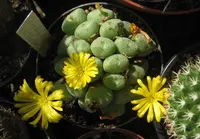
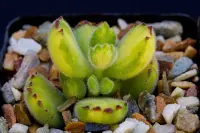
Conophytum meyeri is a small, clumping succulent from arid regions of South Africa and Namibia. It forms tight cushions of paired, fused leaves that resemble tiny stones. The leaves are usually rounded to slightly elongated, with a smooth surface and muted grey-green tones, sometimes with fine markings. In autumn, it produces daisy-like flowers that emerge from the slit between the leaf pairs. This species follows a winter-growing cycle, resting in summer under a dry papery sheath. Its compact size and slow growth make it suitable for small pots and windowsills, but the unusual seasonal rhythm means it can be challenging to care for Conophytum meyeri at first.

Care Difficulty
Hard Care

Light Preference
Partial Sun

Water Requirements
Low Water

Temperature Preference
Tropical / Frost Sensitive

Hardiness Zone
10–11

Soil Texture
Sandy, Rocky, Loamy

Soil pH
Slightly acidic (6.5–7.0), Neutral (7.0)

Soil Drainage
Well-drained

Fertilization
Minimal (feed rarely)
Scan your plant to receive care tips personalized for your specific plant
Available on iOS and Android
This compact succulent prefers bright, cool, and gentle sun rather than intense all-day exposure.
Watering must follow the plant’s seasonal rhythm and the soil’s dryness rather than a fixed calendar.
This species prefers cool to mild conditions, with careful protection from frost and intense heat.
Humidity is rarely a concern, as this species prefers very dry air similar to desert conditions.
Soil for Conophytum meyeri must be very fast-draining and highly mineral to prevent root and stem rot.
This compact species is well suited to small containers, provided excess moisture is controlled carefully.
This compact succulent needs only light feeding to stay healthy in containers.
This species needs minimal pruning, focused mainly on cleanliness and monitoring plant health.
Repotting is infrequent and should be done gently to avoid damaging the shallow root system.
Propagation is usually done slowly through division or from seed under controlled conditions.
This plant dislikes prolonged cold and wet conditions and benefits from sheltered winter treatment in most climates.

Plant Health Check
Not sure what's wrong with your plant? Check your plant's health inside the app.
This species opens its small tubular flowers in the evening and night, an adaptation to attract nocturnal moth pollinators in its arid South African habitat.
It forms tiny paired leaf bodies that often stay under 1 cm tall, allowing the plant to sit low in rock crevices and avoid intense sun and drying winds.
After the growing season, the older leaves dry into a thin, papery sheath around the new body, helping camouflage it against surrounding pebbles and reducing water loss during summer dormancy.
This species grows slowly, typically adding only a few new pairs of bodies each year. Expect several years before a small cluster forms. Patience is essential when growing Conophytum meyeri from young plants or seed.
Keep your plants happy and healthy with plant identification, disease detection, and easy care guidance.