Encourage Compact Mats
Shear back spent flower stems and any elongated shoots by 1–2 in after flowering to keep cushions dense and prevent gaps that invite weeds.

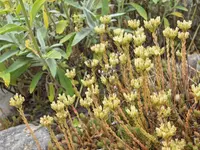
European stonecrop (Petrosedum ochroleucum) is a small, hardy succulent groundcover in the stonecrop family. It forms low, dense mats of fleshy, needle-like leaves topped with clusters of pale yellow star-shaped flowers.
This species is native to rocky slopes and dry, open areas in parts of Europe, where it thrives in thin, well-drained soils. Its drought tolerance, cold hardiness, and slow, compact growth make it a low-maintenance choice for rock gardens, green roofs, and troughs.
It prefers full sun, gritty soil, and only light to moderate watering, which simplifies how to care for European Stonecrop in most home gardens.

Care Difficulty
Easy Care

Light Preference
Full Sun

Water Requirements
Low Water

Temperature Preference
Cold Hardy

Hardiness Zone
4–9

Soil Texture
Sandy, Loamy, Rocky

Soil pH
Slightly acidic (6.5–7.0), Slightly alkaline (7.0–7.5)

Soil Drainage
Well-drained

Fertilization
Minimal (feed rarely)
Scan your plant to receive care tips personalized for your specific plant
Available on iOS and Android
This low-growing succulent prefers bright conditions and copes well with full sun in most temperate climates.
This drought-tolerant succulent needs infrequent but thorough watering in sharply drained soil.
This hardy succulent tolerates a wide temperature range but performs best in cool to warm conditions.
This drought-tolerant succulent handles typical indoor humidity without special measures.
This plant needs very fast-draining, mineral-rich soil to prevent root rot.
This species is well suited to container growing, including shallow trays and rock-garden pots.
This drought-tolerant succulent needs only light feeding, so focus on avoiding overfertilization rather than pushing fast growth.
Petrosedum ochroleucum responds well to light pruning that keeps mats dense and prevents bare, woody patches.
This species dislikes frequent disturbance, so repot or transplant only when clear signs show the plant has outgrown its space.
This mat-forming succulent is commonly propagated to fill rock gardens, troughs, or groundcover areas.
This hardy succulent usually needs minimal winter care in most temperate climates.

Plant Health Check
Not sure what's wrong with your plant? Check your plant's health inside the app.
This species often anchors itself in shallow soil pockets of limestone and other calcareous rocks, using its fibrous roots to exploit tiny fissures that many other plants cannot colonize.
In many climates it remains partly evergreen, forming tight rosettes of narrow leaves that persist through winter and allow it to start photosynthesizing early in spring.
Its cylindrical, slightly fleshy leaves store water and reduce surface area, which lowers transpiration and supports survival on exposed, sun‑baked slopes in its native European range.

In traditional central European dry-stone walls, this species is one of the characteristic pioneer plants, often appearing spontaneously in mortar joints and wall crevices, where it helps stabilize the structure by binding loose particles with its root system.
This species spreads slowly to moderately by short creeping stems and occasional self-seeding. It usually forms tidy mats rather than taking over beds, but in very lean, sunny rock gardens it can gradually occupy available gaps.
Keep your plants happy and healthy with plant identification, disease detection, and easy care guidance.