Seasonal Rest Control
During the summer and winter rest periods, keep the pot completely dry and avoid disturbing the plant so the old leaf pair can safely dry and the new pair can develop inside.

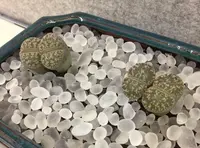
Living stones are small succulent plants that mimic pebbles or gravel. Each plant consists of a pair of thick leaves joined at the center, often with intricate patterns on top. Lithops lesliei var. venteri is a selected variety with distinctive markings and color tones that help it blend into its rocky habitat.
This species is native to arid regions of southern Africa, where it survives long dry periods with minimal water. It stays compact and grows slowly, which suits indoor container culture. Understanding how to care for Living Stones mainly involves controlling water, providing strong light, and using very free-draining mineral soil so the roots do not stay wet for long.

Care Difficulty
Hard Care

Light Preference
Full Sun

Water Requirements
Low Water

Temperature Preference
Tropical / Frost Sensitive

Hardiness Zone
10–11

Soil Texture
Sandy, Rocky

Soil pH
Slightly acidic (6.5–7.0), Neutral (7.0)

Soil Drainage
Well-drained

Fertilization
Minimal (feed rarely)
Scan your plant to receive care tips personalized for your specific plant
Available on iOS and Android
This compact succulent needs bright light but must be protected from harsh, prolonged midday sun.
Watering must be sparse and timed to the plant’s growth cycle to prevent rot.
This species prefers warm, dry conditions with a marked difference between summer heat and cooler winters.
This species prefers very dry air and usually needs no special humidity management in homes.
This dwarf succulent needs a very fast-draining, mineral-based mix that mimics coarse desert grit.
This species is very suitable for container growing due to its compact root system and slow growth.
Lithops lesliei var. venteri grows well with very minimal feeding in lean, gritty soil.
Lithops lesliei var. venteri does not need structural pruning, only light cleanup when necessary.
This species prefers to stay undisturbed and only needs infrequent repotting in long-lived container setups.
Propagation of this species is usually done from seed and requires patience and stable conditions.
This plant needs cool, dry winter conditions and is not suitable for freezing outdoor climates.

Plant Health Check
Not sure what's wrong with your plant? Check your plant's health inside the app.
The venteri form shows unusually large, pale translucent windows on the leaf tops with a fine, intricate network of darker lines, a pattern that helps light penetrate to the photosynthetic tissues buried deeper in the body while still providing camouflage on pale, quartz-rich gravels.
In the wild this variety is naturally restricted to specific areas of South Africa’s Northern Cape, where it grows among light-colored stones and coarse sandy soils, and its pale, creamy-grey coloration closely matches these local substrates.
Like other lesliei forms, this variety renews itself by absorbing an older leaf pair almost completely to form a new one inside, a slow annual cycle that is tightly linked to the rhythm of sparse late-summer to autumn rains in its native habitat.

The venteri variety was described from plants found near the small town of Prieska in South Africa, and its distinct pale coloration and window pattern were considered stable enough in those local populations that taxonomists recognized it formally as a separate variety within Lithops lesliei.
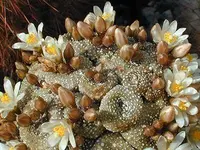
This species usually flowers in late summer to autumn once fully mature, often after several years. Lack of blooms is normal in young plants. Stable cool, dry winter rest and bright conditions support the natural flowering cycle.
Keep your plants happy and healthy with plant identification, disease detection, and easy care guidance.