Winter rain management
In climates with wet winters, grow plants in slightly raised mounds or on sloped ground so excess rain drains away quickly and does not rot the shallow roots.

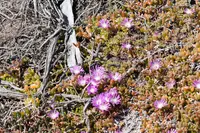
Purple dewplant, Disphyma crassifolium, is a low-growing succulent from coastal areas of Australia and South Africa. It forms dense mats of glossy, cylindrical leaves with bright purple to pink daisy-like flowers.
This species naturally occurs on seaside cliffs, dunes, and rocky ground, where it tolerates salt spray, wind, and poor soils. It is often used as a groundcover in mild climates and can also be grown in containers.
Its drought tolerance and ability to cope with sandy, fast-draining soil make it relatively easy to manage if overwatering is avoided. In general, those who want to care for Purple Dewplant should provide plenty of light, low to moderate moisture, and gritty soil.

Care Difficulty
Easy Care

Light Preference
Full Sun

Water Requirements
Low Water

Temperature Preference
Warm Climate

Hardiness Zone
9–11

Soil Texture
Sandy, Loamy, Rocky

Soil pH
Slightly acidic (6.5–7.0), Slightly alkaline (7.0–7.5)

Soil Drainage
Well-drained

Fertilization
Minimal (feed rarely)
Scan your plant to receive care tips personalized for your specific plant
Available on iOS and Android
This coastal succulent prefers bright, direct light similar to full sun in its native habitat.
This species is drought-tolerant and prefers thorough but infrequent watering.
This coastal succulent handles warmth and mild cold but is damaged by hard frost.
This coastal succulent is adapted to dry air, so indoor humidity is rarely a concern.
This species needs fast-draining, sandy soil that mimics its natural coastal habitat.
This plant is well suited to container growing, especially in shallow, wide pots that allow it to spread.
This coastal succulent needs only light feeding to stay healthy and flowering.
Pruning Disphyma crassifolium is mainly cosmetic and helps keep mats dense and tidy.
This groundcover succulent is usually transplanted rather than frequently repotted.
This species spreads well and is typically propagated to extend groundcover areas.
In mild coastal climates this plant is fairly tolerant, but winter care matters in colder regions.

Plant Health Check
Not sure what's wrong with your plant? Check your plant's health inside the app.
This species stores salty water in its thick, succulent leaves, allowing it to maintain cell function in highly saline coastal habitats where many non-succulent plants cannot survive.
It often grows in dense mats on coastal dunes and rocky shores, where its sprawling stems trap sand and reduce erosion, helping to stabilize shorelines in southern Australia and New Zealand.
The plant tolerates regular sea spray and occasional seawater inundation because its leaf surface and internal salt-compartmentalizing tissues limit salt damage to photosynthetic cells.

In its native range, this species can form extensive, almost monocultural carpets on exposed coastal rock platforms, creating a distinctive purple-pink seasonal display that is visible from offshore and often used by botanists to map shoreline plant communities from a distance.
Lack of flowers is often caused by insufficient light, overly rich or wet soil, or heavy shade from neighboring plants. Check for root disturbance or recent repotting, as stress can pause flowering for a season.
Keep your plants happy and healthy with plant identification, disease detection, and easy care guidance.