

Field Bindweed Identification (Convolvulus arvensis)

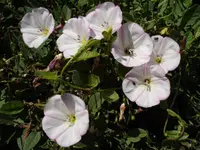
To recognize Field Bindweed, look for slender twining stems that trail or climb, alternate arrowhead-shaped leaves with pointed basal lobes, and funnel-shaped flowers about 1 inch (2.5 cm) across.

The plant forms low mats or threads through nearby stems, with each leaf borne singly along the stem rather than in pairs.

Convolvulus arvensis Identification

Check Your Plant ID

Take a photo and use Botan to confirm your plant identification.

Clear images work best. Avoid photos taken too close or too far away

Check the vine’s leaves, flowers, and twining stems.

  • Slender stems trail or climb by twining, often forming mats or scrambling through nearby plants.
  • Leaves are alternate and arrowhead-shaped, usually 1-2 inches (2.5-5 cm) long, with two pointed basal lobes.
  • Flowers are funnel-shaped, about 1 inch (2.5 cm) across, white to pink, with five faint lengthwise bands.
  • Each flower sits alone on a long stalk from the leaf axil, where leaf meets stem.

Look for the mix of twining stems, arrowhead leaves, and single funnel flowers.

Field Bindweed shows clear visual shifts from early shoots to flowers and seed capsules.

  • Seedling: Seedlings have a pair of broad, rounded seed leaves, then small alternate true leaves that soon show the species’ first arrowhead-like outline.
  • Young plant: Young plants form slender trailing or twining stems with spaced alternate leaves; blades are still relatively narrow and less deeply notched at the base.
  • Flowering stage: Open funnel-shaped flowers, usually white to pale pink, appear singly from leaf axils and measure about 1 inch (2.5 cm) across on stalked buds.
  • Fruiting stage: After flowering, the corolla drops and a small rounded capsule remains, enclosed by persistent bracts and sepals, making the axil look firmer and more compact.

In spring, Field Bindweed sends up slender twining stems with small arrowhead-shaped leaves. By late spring through summer, the funnel-shaped white to pink flowers become the clearest seasonal clue and can appear over a long period. Later in the season, small capsule fruits may follow the flowers. After frost or winter cold, the top growth dies back, leaving no showy above-ground features until new shoots return.

Several twining weeds can be mistaken for Field Bindweed.

hedge bindweed(Calystegia sepium)

Similar funnel-shaped flowers and vining stems cause confusion. It is usually larger overall, with flowers often 2-3 inches (5-8 cm) wide, and its two leafy bracts sit directly below and partly cover the flower base.

black bindweed(Fallopia convolvulus)

It also twines through other plants and has arrowhead-shaped leaves. Unlike Convolvulus arvensis, it bears tiny greenish flowers in clusters rather than large open funnels, and later makes small three-sided dark fruits.

Convolvulus arvensis is native to Europe and much of temperate Asia. It occurs in open, disturbed places such as fields, roadsides, waste ground, gardens, and dry grassland. That setting is useful for identification because this species is especially associated with repeatedly disturbed ground in settled areas, rather than woodland, wetlands, or shady forest edges. Finding it in sunny, cultivated or neglected sites helps narrow the ID.

Not Sure About the ID?

Upload a photo to Botan to identify the plant or confirm your match before you label it or compare similar species.

FAQ

Flowers are usually white to pale pink, often with faint darker pink stripes. The funnel-shaped corolla is a useful clue when identifying Field Bindweed, especially alongside the arrow-shaped leaves and twining stems.

More Plant Identification Guides

Identify First. Learn What Comes Next.

Use Botan to identify a plant from a photo, then get species-specific plant details, care information, and common problems.

Botan app identifying a plant from a photo
12 Best Cold-Hardy Vegetables for Cold Weather

7 min read · 13 Oct 2026

12 Best Cold-Hardy Vegetables for Cold Weather

Cold-hardy vegetables can keep a garden productive through chilly fall, winter, and early spring weather. This guide covers 12 reliable crops, their frost tolerance, and practical growing tips for better cold-season harvests.

Plant Recommendations

12 Best Cold-Hardy Vegetables for Cold Weather
10 Easy Garden Flowers to Grow

8 min read · 10 Sept 2026

10 Easy Garden Flowers to Grow

Discover 10 garden flowers that require minimal care. Learn which characteristics make plants easy to grow and follow tips on how to create a beautiful corner from beginner-friendly blooms on your property.

Beginner Guides
10 Easy Garden Flowers to Grow
Plants That Repel Bugs – 20 Effective Options

12 min read · 16 Jul 2026

Plants That Repel Bugs – 20 Effective Options

Mosquitoes on the patio? Gnats in the kitchen? Some plants keep them away with the scent of their own leaves. Here are 20 that deal with mosquitoes, flies, aphids, and more, plus where to put them so they help.

Plant Recommendations
Plants That Repel Bugs – 20 Effective Options