Spore-friendly substrate
Prepare a low-nutrient, leaf-litter rich bed over existing tree roots (especially beech or birch), as this encourages mycorrhizal association and supports more reliable fruiting when growing Silvery-violet Cort outdoors.

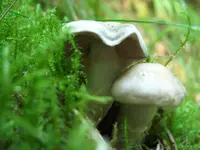
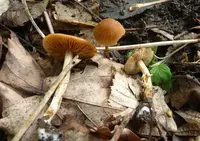
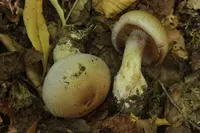
Silvery-violet Cort (Cortinarius alboviolaceus) is not a plant but a woodland mushroom found mainly in temperate forests of Europe and North America. It grows on the ground among leaf litter, often near birch or conifer trees, with a pale lilac to silvery-violet cap and similar-colored gills that fade as it ages.
This species typically appears in late summer to autumn and forms mycorrhizal partnerships, meaning it exchanges nutrients with tree roots. Because it depends on specific forest soils and tree partners, it is not practical to cultivate at home, and most guides do not explain how to care for Silvery-violet Cort.

Care Difficulty
Hard Care

Light Preference
Partial Shade

Water Requirements
Keep Soil Moist

Temperature Preference
Cool Climate

Hardiness Zone
Unknown

Soil Texture
Loamy, Silty, Organic-rich

Soil pH
Strongly acidic (4.5–5.5), Acidic (5.5–6.5)

Soil Drainage
Moist but well-drained

Fertilization
Minimal (feed rarely)
Scan your plant to receive care tips personalized for your specific plant
Available on iOS and Android
This ectomycorrhizal fungus prefers cool, shaded forest light rather than direct sun exposure.
This woodland fungus depends on consistently moist, not waterlogged, soil around its tree partners.
This species is adapted to cool to mild climates and typically fruits in temperate forest conditions.
Humidity management is not a practical care factor because this is a wild ectomycorrhizal fungus rather than a cultivated houseplant.
This forest fungus depends on natural, undisturbed soils and is not realistically managed through standard plant-style soil preparation.
This species is not suitable for container growing, as it depends on living tree roots and complex forest soil communities that containers cannot replicate.
Cortinarius alboviolaceus forms mycorrhizal partnerships with tree roots and does not need direct fertilization like a typical garden plant.
Pruning is not applicable for Cortinarius alboviolaceus, because it is a wild mycorrhizal fungus rather than a plant with stems or branches to shape.
This fungus is not suited to normal repotting; it relies on living tree roots in soil and is rarely maintained in containers.
Propagation of Cortinarius alboviolaceus is specialized and not practical for home growers, since it depends on microscopic spores and complex mycorrhizal development.
Silvery-violet Cort is a temperate woodland fungus that is generally cold hardy and does not require active winter care from gardeners.

Plant Health Check
Not sure what's wrong with your plant? Check your plant's health inside the app.
Fresh fruit bodies of this species show a distinct pale to silvery violet tint on the cap and stem, but the color quickly fades to grayish or brownish tones as the mushroom ages.
The cap surface is often covered by a slimy gelatinous layer in wet weather, yet it can appear relatively dry and silky when conditions are less humid, which can make field identification challenging.
This fungus forms ectomycorrhizal associations with the roots of birch and various conifers, exchanging mineral nutrients for sugars and contributing to forest soil health in temperate and boreal regions.

The spores of this species are strongly warted and rusty brown, and their characteristic ornamentation under a microscope is one of the key features mycologists use to separate it from several very similar violet Cortinarius species.
This species is considered inedible and potentially poisonous. Identification within its genus is difficult, and several close relatives are dangerously toxic. It should never be eaten or taste-tested, even in small amounts, by humans or animals.
Keep your plants happy and healthy with plant identification, disease detection, and easy care guidance.