Spore-friendly site
Leave some mature fruiting bodies in place to drop spores and avoid disturbing the surrounding leaf litter so the underground mycelium can expand naturally.

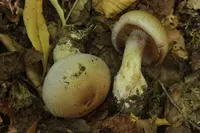
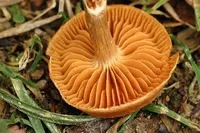
The big bellied webcap, Cortinarius largus, is a fleshy woodland mushroom rather than a leafy plant. It has a rounded, often swollen stem and a smooth cap in muted lilac to brown tones. Gills are covered by a fine cobweb-like veil when young, a typical trait of the genus.
This species is naturally found in coniferous and mixed forests across parts of Europe and North America, growing on the ground in soil rich in decaying organic matter. It forms mycorrhizal partnerships with trees, which makes it unsuitable for ordinary pot culture and explains why how to care for big bellied webcap is rarely discussed for home growing.
In nature it prefers cool, moist, shaded conditions and undisturbed forest soil with stable moisture and good leaf litter cover.

Care Difficulty
Hard Care

Light Preference
Partial Shade

Water Requirements
Keep Soil Moist

Temperature Preference
Cool Climate

Hardiness Zone
Unknown

Soil Texture
Loamy, Peaty, Organic-rich

Soil pH
Strongly acidic (4.5–5.5), Acidic (5.5–6.5)

Soil Drainage
Moist but well-drained

Fertilization
Minimal (feed rarely)
Scan your plant to receive care tips personalized for your specific plant
Available on iOS and Android
This woodland fungus prefers low to moderate light that mimics a shaded forest floor.
This mycorrhizal fungus depends on consistently moist, not saturated, soil around its host trees.
This species thrives in cool to mild conditions typical of temperate forests.
Humidity is not a meaningful care factor for Cortinarius largus in typical outdoor conditions, so dedicated humidity management is unnecessary when observing this big bellied webcap in nature.
This ectomycorrhizal fungus depends on natural forest soil conditions rather than prepared mixes.
This woodland fungus is not suitable for container growing under normal home or garden conditions, so container care is not recommended.
This mycorrhizal fungus does not need direct fertilization, as added nutrients can disrupt its natural partnership with host tree roots.
Pruning is not applicable to Cortinarius largus, because it is a wild mycorrhizal mushroom rather than a managed garden plant.
Transplanting Cortinarius largus is rarely successful because it depends on a specific mycorrhizal relationship with host tree roots in undisturbed soil.
Propagation of Cortinarius largus in garden settings is not practical, as it relies on complex interactions with tree roots and soil microbes.
No special winter care is needed, since this forest mushroom is adapted to local cold conditions and survives underground as mycelium.

Plant Health Check
Not sure what's wrong with your plant? Check your plant's health inside the app.
Mature specimens often have a noticeably swollen, belly-like midsection on the stem, which helps distinguish this species from other purple Cortinarius mushrooms in mixed coniferous and deciduous forests.
This fungus forms ectomycorrhizal associations with trees such as pine and birch, wrapping around fine roots and improving water and nutrient uptake in exchange for sugars from the host tree.
The cap starts lilac to violet when young and gradually fades to brownish tones as spores mature, while the gills shift from pale shades to rusty brown as the thick spore print develops.

Although common in suitable European woodlands, this species is considered inedible not only because of potential toxins but also because it belongs to a genus that includes several seriously poisonous look-alikes, so mycologists advise against collecting it for food at all.
This mushroom is considered inedible and potentially poisonous. Identification within the Cortinarius genus is difficult, and several related species are deadly. It should never be collected for food or tasting under any circumstances.
Keep your plants happy and healthy with plant identification, disease detection, and easy care guidance.