


Spore-print monitoring
Place a clean white card under mature caps overnight to collect spores; a consistent lilac-brown spore print indicates healthy fruiting and helps track whether the mycelium is still actively reproducing in that spot.

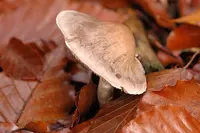
Variable webcap, Cortinarius anomalus, is a small woodland mushroom rather than a typical houseplant. It forms slender stems with gray to brown caps that often show lilac or violet tones when young. The cap surface and gills change color as it ages, which contributes to its common name.
This species occurs mainly in temperate forests of Europe and North America, growing on soil among leaf litter, often with beech, oak, or conifers. It forms mycorrhizal partnerships with tree roots, so it cannot be reliably cultivated indoors or in pots. Because of this dependency, it is considered difficult to grow intentionally, and attempts to care for variable webcap should focus on conserving suitable woodland habitat rather than home culture.

Care Difficulty
Hard Care

Light Preference
Partial Shade

Water Requirements
Keep Soil Moist

Temperature Preference
Cool Climate

Hardiness Zone
Unknown

Soil Texture
Loamy, Organic-rich, Peaty

Soil pH
Strongly acidic (4.5–5.5), Acidic (5.5–6.5)

Soil Drainage
Moist but well-drained

Fertilization
Minimal (feed rarely)
Scan your plant to receive care tips personalized for your specific plant
Available on iOS and Android
This woodland fungus prefers low to moderate light typical of shaded forest floors.
This ectomycorrhizal fungus depends on consistently moist, not waterlogged, woodland soil.
This species is adapted to cool to mild forest climates with distinct seasonal shifts.
Humidity is not a primary controllable factor for variable webcap, which relies mainly on natural forest conditions rather than indoor adjustment.
Cortinarius anomalus depends on natural forest soil rather than managed potting mixes, but understanding its substrate helps when assessing habitat conditions.
This woodland fungus is not suitable for container growing because it requires complex mycorrhizal relationships with tree roots in undisturbed soil ecosystems.
This wild ectomycorrhizal fungus partners with tree roots and generally should not be fertilized directly.
Cortinarius anomalus is a wild mushroom and is not managed through pruning in typical horticultural practice.
This mycorrhizal fungus is not suited to standard repotting and is best left in its natural woodland setting.
Deliberate propagation of Cortinarius anomalus is not recommended for home growers and is rarely successful.
This woodland fungus is naturally cold hardy in its native range and does not require deliberate winter care.

Plant Health Check
Not sure what's wrong with your plant? Check your plant's health inside the app.
The young fruiting bodies have a cobweb-like partial veil, called a cortina, that stretches between the cap margin and the stem and often leaves rusty-brown spore deposits on the stem as it matures.
This species forms ectomycorrhizal associations with both deciduous and coniferous trees in temperate forests, exchanging mineral nutrients for sugars from the host tree roots.
Its cap color ranges from grayish-brown to lilac-tinged, often fading or changing with age and moisture, which makes reliable identification dependent on a combination of features rather than color alone.
This species is not considered edible and should be treated as potentially poisonous. Many Cortinarius look similar, and some contain dangerous toxins that can damage the kidneys. For safety, do not eat it under any circumstances.
Keep your plants happy and healthy with plant identification, disease detection, and easy care guidance.

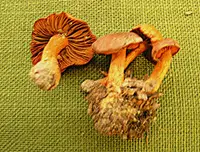
cinnabar webcap
Cortinarius cinnabarinus
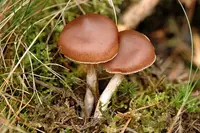
Cortinarius brunneus
Cortinarius brunneus
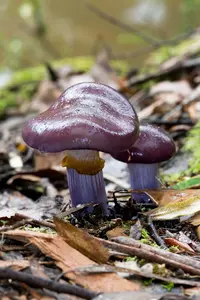
Emperor Cortinar
Cortinarius archeri
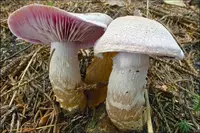
goatcheese webcap
Cortinarius camphoratus
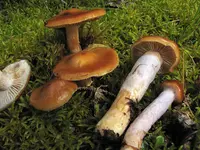
blue-girdled webcap
Cortinarius collinitus
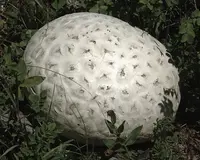
Western Giant Puffball
Calvatia booniana
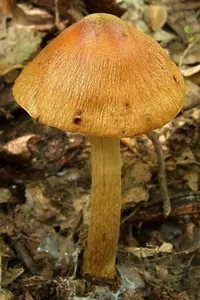
wrinkled cortinarius
Cortinarius corrugatus
umbrella polypore
Polyporus umbellatus