


Soil companion checks
When collecting or attempting cultivation, always record associated tree species (such as spruce, pine, or birch), since the fungus is mycorrhizal and will only fruit reliably where compatible roots are present.

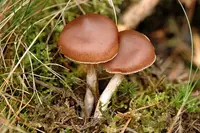
Cortinarius brunneus is a brown, webcap mushroom species, not a typical houseplant. It forms fleshy caps and slender stems, usually in damp forest habitats. The caps are medium-sized, with earthy brown tones and fine radial fibers. Gills start paler and darken as spores mature.
This fungus is typically found in coniferous and mixed woodlands, often in cooler climates of the Northern Hemisphere. It forms mycorrhizal associations, meaning it lives in close partnership with tree roots and cannot be grown as a normal potted plant.
Due to this specialized lifestyle, it is not suitable for casual cultivation, and practical guides on how to care for Cortinarius brunneus are very limited and mostly of academic interest.

Care Difficulty
Hard Care

Light Preference
Partial Shade

Water Requirements
Regular Water

Temperature Preference
Cool Climate

Hardiness Zone
Unknown

Soil Texture
Loamy, Silty, Organic-rich

Soil pH
Acidic (5.5–6.5)

Soil Drainage
Moist but well-drained

Fertilization
Minimal (feed rarely)
Scan your plant to receive care tips personalized for your specific plant
Available on iOS and Android
This woodland mushroom prefers shaded forest conditions with very limited direct sun exposure.
This ectomycorrhizal mushroom depends on stable, naturally moist but not waterlogged forest soil.
This forest fungus fruits best in cool to mild conditions typical of temperate woodlands.
This forest mushroom depends on consistently moist, high-humidity conditions, not dry air.
This ectomycorrhizal fungus relies on specific forest soil conditions rather than standard potting substrates.
This species is not realistically suitable for container growing because it requires complex mycorrhizal relationships with tree roots and stable forest soil conditions.
This wild ectomycorrhizal fungus does not benefit from garden fertilization and should not be fed like a potted plant.
Pruning is not applicable to Cortinarius brunneus, as it is a wild mycorrhizal mushroom rather than a garden shrub or houseplant.
This species is not suited to normal repotting or transplanting, because it lives in soil as a symbiont of tree roots.
Intentional propagation of this ectomycorrhizal fungus is technically complex and rarely attempted by home growers.
Specific winter care is unnecessary because the organism persists as underground mycelium that tolerates normal seasonal cold in its native range.

Plant Health Check
Not sure what's wrong with your plant? Check your plant's health inside the app.
This species forms ectomycorrhizal associations with conifer trees, especially spruces and pines, where its hyphae wrap around fine roots and help the host tree absorb water and minerals in exchange for sugars.
It belongs to a group characterized by a cortina, a very fine, cobweb-like partial veil that covers the gills in young fruiting bodies and later leaves rusty-brown spore deposits on the stem.
Mature fruiting bodies release brown to rusty-brown spores, a key diagnostic feature that helps separate this species from pale-spored woodland mushrooms in the same habitats.
This fungus is not recommended for consumption. Identification within the genus is difficult and several closely related species are seriously poisonous. For safety, it is best treated as inedible and left for observation only.
Keep your plants happy and healthy with plant identification, disease detection, and easy care guidance.

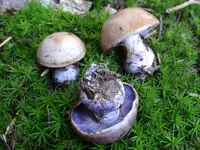
blushing webcap
Cortinarius cyanites
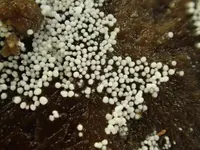
couscous crust
Bulbillomyces farinosus
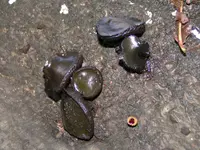
Poor Man's Licorice
Bulgaria inquinans
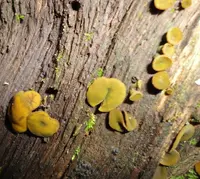
olive-brown cup
Chlorencoelia versiformis
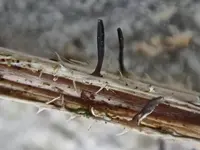
Acrospermum compressum
Acrospermum compressum
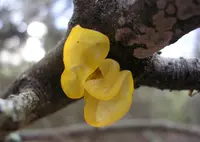
witch's butter
Tremella mesenterica
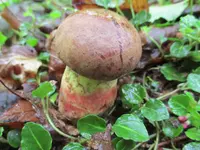
Butyriboletus brunneus
Butyriboletus brunneus
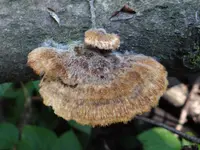
Coriolopsis trogii
Coriolopsis trogii