


Spore-friendly setup
If cultivating for study, place caps over clean paper or foil in a closed container for 12–24 hours to collect a spore print before attempting any advanced growing methods.

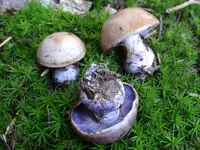
Blushing webcap (Cortinarius cyanites) is a woodland mushroom, not a houseplant, known for its fleshy violet to brownish caps that often bruise reddish or wine-colored. It forms mycorrhizal partnerships with trees, meaning it grows in soil connected to living roots rather than on its own in pots.
This species is native to temperate forests in Europe and parts of North America, usually appearing on the ground among leaf litter or moss. Identification is difficult, and similar species can be dangerously poisonous, so attempts to care for blushing webcap indoors or use it as an edible mushroom are not recommended.
In nature, it prefers moist, shaded forest habitats with undisturbed, organic-rich soil and stable tree partners.

Care Difficulty
Hard Care

Light Preference
Partial Shade

Water Requirements
Keep Soil Moist

Temperature Preference
Cool Climate

Hardiness Zone
Unknown

Soil Texture
Loamy, Silty, Organic-rich

Soil pH
Strongly acidic (4.5–5.5), Acidic (5.5–6.5)

Soil Drainage
Moist but well-drained

Fertilization
Minimal (feed rarely)
Scan your plant to receive care tips personalized for your specific plant
Available on iOS and Android
Cortinarius cyanites is a woodland fungus that fruits best in cool, shaded forest conditions with very limited direct sun.
This mycorrhizal fungus depends on consistently moist, well-drained forest soil rather than direct watering to its fruiting bodies.
This woodland species fruits best in cool to mild conditions and is sensitive to both hard frost and intense heat at the soil surface.
Humidity is not a relevant controllable factor for Cortinarius cyanites, which relies mainly on suitable outdoor soil and host trees rather than air moisture.
This ectomycorrhizal fungus depends on outdoor forest soil conditions rather than prepared potting mixes.
This species is not suitable for container growing, as it requires a living tree root system and stable woodland soil conditions to complete its life cycle.
Cortinarius cyanites is a wild mycorrhizal fungus that normally does not require or benefit from conventional fertilization.
Pruning is not applicable to Cortinarius cyanites, since it is a wild, ground-dwelling fungus rather than a garden shrub or tree.
This fungus forms symbiotic relationships with tree roots and is not suited to normal container culture or routine transplanting.
Intentional propagation of Cortinarius cyanites is rarely successful in home or garden settings and is not commonly practiced.
Special winter care is not required, as this woodland fungus naturally tolerates typical seasonal cold in its native range.

Plant Health Check
Not sure what's wrong with your plant? Check your plant's health inside the app.
When cut or damaged, the whitish flesh of this species quickly turns violet to bluish, especially in the stipe and lower gills, which helps distinguish it from many similar brown Cortinarius species.
This fungus forms ectomycorrhizae, a nutrient-trading root partnership, primarily with conifers and sometimes birch in temperate and boreal forests, improving tree nutrient uptake while receiving sugars in return.
Although its exact toxicity is not fully resolved, it belongs to a genus that includes dangerously nephrotoxic (kidney-damaging) species, so specialists strongly advise against consumption due to difficult field identification and possible confusion with deadly relatives.
This mushroom is considered poisonous and must not be eaten. It contains toxins that may damage kidneys and other organs. Identification within Cortinarius is difficult, so all similar species should be treated as unsafe for consumption.
Keep your plants happy and healthy with plant identification, disease detection, and easy care guidance.

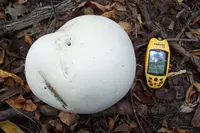
giant puffball
Calvatia gigantea
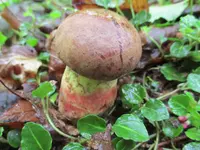
Butyriboletus brunneus
Butyriboletus brunneus
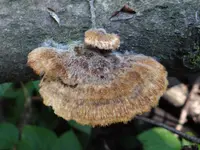
Coriolopsis trogii
Coriolopsis trogii
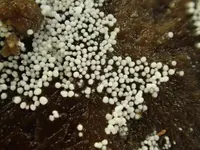
couscous crust
Bulbillomyces farinosus
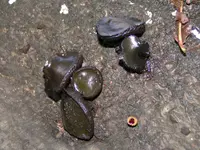
Poor Man's Licorice
Bulgaria inquinans
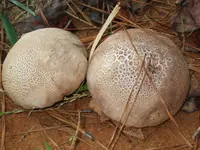
Purple-Spored Puffball
Calvatia cyathiformis
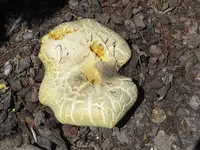
Golden Bolete
Buchwaldoboletus sphaerocephalus
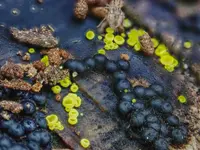
Sulphur Disco
Calycina claroflava