


Use host debris
When establishing a patch, mix in well-rotted leaf litter and small twigs from under compatible host trees such as spruce or fir to provide familiar organic cues for the mycorrhizal fungus.

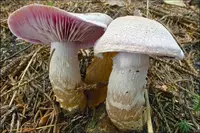
The goatcheese webcap, Cortinarius camphoratus, is a wild mushroom-forming fungus rather than a traditional garden plant. It produces thick, pale lilac to grayish caps with dense, stocky stems and a cobweb-like veil typical of webcaps.
This species grows naturally in coniferous and mixed forests, mainly in temperate parts of Europe and North America, where it forms mycorrhizal partnerships with tree roots. It is not practical to cultivate at home, so how to care for goatcheese webcap mostly concerns understanding its natural woodland conditions.
Because it depends on complex soil fungi and living trees, it is considered difficult to impossible to grow reliably in gardens or containers.

Care Difficulty
Hard Care

Light Preference
Partial Shade

Water Requirements
Regular Water

Temperature Preference
Cool Climate

Hardiness Zone
Unknown

Soil Texture
Loamy, Peaty, Organic-rich

Soil pH
Strongly acidic (4.5–5.5), Acidic (5.5–6.5)

Soil Drainage
Moist but well-drained

Fertilization
Minimal (feed rarely)
Scan your plant to receive care tips personalized for your specific plant
Available on iOS and Android
This forest-dwelling fungus prefers cool, subdued light that mimics its native conifer woodland habitat.
This ectomycorrhizal fungus depends on consistently moist, not waterlogged, forest soil.
This species favors cool, temperate conditions typical of conifer forests.
Humidity is not a practical cultivation factor for goatcheese webcap, which is not realistically maintained as a domestically grown fungus.
Soil management is not applicable for typical home culture, as this ectomycorrhizal fungus depends on living tree roots rather than standalone substrates.
This species is not suitable for container growing, as it relies on symbiosis with tree roots in natural soil ecosystems rather than isolated pots.
Cortinarius camphoratus is a wild ectomycorrhizal fungus that should not be fertilized directly, as added nutrients can disrupt its natural partnerships with host trees.
Pruning is not applicable to Cortinarius camphoratus, as it is a wild mushroom producing temporary fruiting bodies rather than long-lived stems or branches.
Transplanting Cortinarius camphoratus is rarely successful, since this fungus depends on delicate root partnerships with specific host trees in stable soil.
Practical propagation of Cortinarius camphoratus is difficult and rarely attempted outside research, because it requires a compatible tree partner and stable woodland soil.
Specific winter care is not required for Cortinarius camphoratus, which is adapted to cold climates and survives as mycelium in the soil between fruiting seasons.

Plant Health Check
Not sure what's wrong with your plant? Check your plant's health inside the app.
The fruiting bodies release a penetrating odor often compared to mothballs, camphor, or rotting potatoes, caused by volatile organic compounds produced in the mushroom tissue.
Young caps, gills, and stems can show pale lilac to violet tones that fade to brownish shades with age, which helps distinguish this species from similar brown cortinarioid mushrooms in the field.
This species forms ectomycorrhizal associations with coniferous trees such as spruce and fir, exchanging mineral nutrients and water from the soil for sugars produced by the host tree through photosynthesis.

This species is considered inedible not only because of its unpleasant odor and taste but also because Cortinarius as a genus contains several dangerously toxic species, so mycologists strongly discourage collecting it for food even where local traditions once treated it as edible.
This species is considered inedible and potentially poisonous. It belongs to a difficult genus with many highly toxic lookalikes. It should never be eaten or tasted, and foraging is unsafe without expert, in-person identification.
Keep your plants happy and healthy with plant identification, disease detection, and easy care guidance.

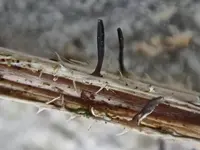
Acrospermum compressum
Acrospermum compressum
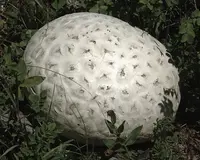
Western Giant Puffball
Calvatia booniana
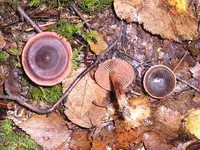
Cortinarius anthracinus
Cortinarius anthracinus
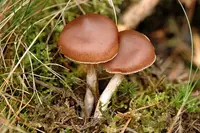
Cortinarius brunneus
Cortinarius brunneus
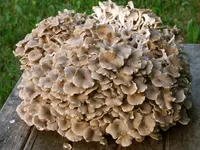
umbrella polypore
Polyporus umbellatus
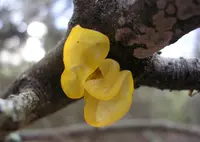
witch's butter
Tremella mesenterica
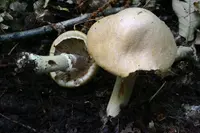
Wrinkled Cortinaria
Cortinarius caperatus
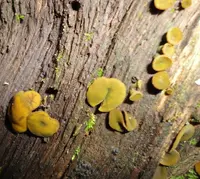
olive-brown cup
Chlorencoelia versiformis