red-banded webcap Care (Cortinarius armillatus)

Also known as: red-banded cortinarius, bracelet cortinarius
red-banded webcap

About red-banded webcap

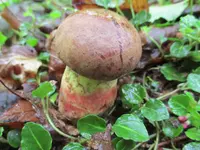
Cortinarius armillatus, commonly called red-banded webcap, is a woodland mushroom rather than a traditional garden plant. It forms medium-sized, rust-brown caps with distinctive red bands on the upper stem and fine web-like veil remnants under the cap.

This species naturally occurs in cool, moist forests, often in association with birch trees, where it forms mycorrhizal partnerships that help trees absorb nutrients. It is not suited to typical home cultivation, since it depends on complex soil fungi networks and specific tree roots. For those studying how to care for red-banded webcap, it is usually observed in its natural habitat rather than actively grown.

Main Plant Requirements

Care Difficulty

Hard Care

Light Preference

Partial Shade

Water Requirements

Keep Soil Moist

Temperature Preference

Cool Climate

Hardiness Zone

Unknown

Soil Texture

Loamy, Silty, Organic-rich

Soil pH

Acidic (5.5–6.5), Slightly acidic (6.5–7.0)

Soil Drainage

Moist but well-drained

Fertilization

Minimal (feed rarely)

Get Personalized Care Plan

Scan your plant to receive care tips personalized for your specific plant

Available on iOS and Android

How to Care for the red-banded webcap

This woodland fungus prefers dappled forest light rather than direct, open sun.

  • Provide 2–5 hours of filtered or dappled light under deciduous trees, with bright but indirect conditions the rest of the day.
  • Tolerates deep partial shade, but dense, evergreen shade can reduce fruiting of red-banded webcap and slow overall mycelium spread.
  • Avoid strong afternoon sun in open clearings, which can overheat and dry the forest floor; morning sun with overhead canopy is ideal in summer.

This mycorrhizal fungus depends on evenly moist, not waterlogged, forest soil.

  • Aim for consistently moist mineral soil, letting only the top 1–2 cm begin to dry between natural rains or supplemental watering in drought.
  • Improve drainage with leaf litter and well-structured soil so excess water runs off; standing water or sour, swampy smell suggests harmful saturation.
  • If caps become brittle and soil is powder-dry, drought stress is likely; if growth stops and soil smells rotten, Cortinarius armillatus may be overwatered.

This species favors cool to mild climates typical of temperate forests.

  • Optimal fruiting occurs around 50–65°F (10–18°C), often in late summer to autumn when soils cool and retain steady moisture.
  • Mycelium in soil can tolerate down to about 25°F (-4°C), but repeated hard freezes without insulating leaf litter reduce survival and fruiting.
  • Sustained heat above 80°F (27°C) with dry conditions slows growth; partial shade, mulch, and consistent soil moisture help buffer summer temperature extremes.

Humidity is not a meaningful care factor because this is a wild ectomycorrhizal mushroom, not a houseplant species.

Cortinarius armillatus grows in natural forest soil and is not practically managed through standard horticultural soil preparation.

  • This ectomycorrhizal fungus depends on undisturbed, moist, organic-rich forest soil with abundant leaf litter and decaying wood.
  • It associates with tree roots, so the natural root zone structure, not a prepared mix, determines aeration, drainage, and pH conditions.
  • Avoid compacted, heavily tilled, or chemically treated ground, which disrupts fungal mycelium and its symbiosis with host trees.
  • Do not attempt container-style mixes with compost, perlite, or bark, as these do not replicate its required forest soil environment.

This species is not suitable for container growing, as it requires living tree roots and complex forest soil conditions that pots cannot provide.

This woodland fungus forms mycorrhizal partnerships with tree roots and normally does not need direct fertilization.

Pruning is not applicable to Cortinarius armillatus because it is a wild, non-woody fungus that fruits seasonally from the soil.

Transplanting this mycorrhizal fungus is rarely successful because it depends on an intact partnership with host tree roots and native soil.

  • Avoid attempting container culture; the species relies on living tree roots rather than potting mixes.
  • If relocation is necessary for research, move host tree seedlings with their surrounding soil intact.
  • Dig widely and shallowly to preserve fine roots and associated fungal threads, then replant promptly.
  • Water the host tree lightly after transplanting and keep soil conditions as close as possible to the original site.

Propagation of Cortinarius armillatus is specialized and usually left to natural spore dispersal in established forests.

Specific winter care is not needed for this cold-hardy woodland fungus, which overwinters naturally in the soil and leaf litter of its forest habitat.

Care Tips

Spore-friendly placement

Site fruiting logs or inoculated substrate near established birch or mixed hardwood stands, since this mycorrhizal fungus fruits more reliably where fine tree roots are dense and undisturbed.

Minimal soil disturbance

Avoid raking, tilling, or compacting soil around the host trees, because intact leaf litter and loose upper soil layers support healthy mycorrhiza and more consistent fruiting bodies.

Leaf litter management

Allow a natural layer of fallen leaves and small twigs to remain over the colonized area, adding only a thin top-up of shredded hardwood leaves each fall to maintain moisture and mimic forest-floor conditions.

Moisture buffering mulch

Use a light, airy mulch such as coarse wood chips from untreated hardwoods over the inoculated zone to buffer short dry spells, but keep the layer thin enough that emerging mushrooms can still push through.

Long-term monitoring

Mark inoculated spots discreetly and record fruiting times each year, which helps refine site selection and timing for caring for red-banded webcap in similar woodland areas on your property.

Common Pests and Diseases

Mycophagous slugs

This pest feeds directly on fruiting bodies, rasping away caps and stems and often hollowing young mushrooms overnight. Symptoms include irregular chew marks, slime trails, and rapid loss of small buttons.

Solution

Hand-pick slugs during damp evenings, use physical barriers like copper tape or coarse grit around fruiting zones, and reduce dense groundcover that shelters them. Where local regulations allow, deploy iron phosphate slug baits placed away from children and pets to reduce grazing pressure on developing mushrooms.

Fungus gnats

These insects lay eggs in moist, organic substrates and their larvae feed on developing fungal tissue and mycelium, leading to misshapen or stunted fruiting bodies. Symptoms include tiny black adult flies hovering near the substrate and fragile, poorly formed caps.

Solution

Reduce excess surface moisture, improve drainage around the fruiting area, and remove heavily infested fruiting bodies. Sticky traps placed near the substrate help reduce adult populations, and a biological control such as Bacillus thuringiensis israelensis (Bti) can be applied to moist forest-culture beds where label directions permit, targeting larvae in the upper substrate layer.

Mite predation

These pests include several small mite species that graze on hyphae and young primordia, weakening the mycelial network and reducing the number of normal fruiting bodies. Symptoms include pin-sized pits, deformed caps, and fine moving specks on stalks or substrate when examined closely.

Solution

Limit the introduction of infested forest litter or compost, and avoid over-accumulation of decaying organic material that supports large mite populations. Remove and discard heavily affected fruiting bodies and, in managed culture setups, refresh or pasteurize substrate batches and improve ventilation to make conditions less favorable for large mite buildups.

Parasitic mold overgrowth

This disease occurs when competitor molds colonize the same substrate and overrun the mycelium, forming fuzzy, discolored patches that suppress mushroom development. Symptoms include cottony white, green, or gray growth on or around fruiting bodies and failure of pins to mature.

Solution

Physically remove contaminated substrate sections and adjacent fruiting bodies, and avoid splashing water that spreads mold spores. Improve air circulation, lower surface wetness, and, in controlled culture, start with clean, well-aged wood or litter while keeping tools and containers thoroughly cleaned to limit reintroduction of mold contaminants.

Interesting Facts

Distinctive red banding

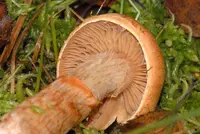
The red-banded webcap is named for its characteristic orange-red to blood-red bands or zones on the upper stipe, which contrast with the otherwise yellowish to brown stem and help distinguish it from many similar brown Cortinarius species.

Strict birch associate

This fungus forms ectomycorrhizal partnerships specifically with birch trees (Betula species), exchanging mineral nutrients and water from the soil for sugars produced by the tree, and is therefore usually found in moist birch or mixed birch-dominated forests.

Rusty spore deposit

Its gills start pale and become cinnamon to rust-brown as the spores mature, leaving a distinctly rusty-brown spore print that is a key diagnostic character in field identification of this species within the large Cortinarius genus.

Botan icon

Did you know?

In several European countries the red-banded webcap is tracked as a vulnerable or regionally threatened species, mainly because drainage, logging, and changes in birch forest management reduce the specific moist birch habitats it depends on for its life cycle.

FAQs about red-banded webcap

This mushroom is considered inedible and potentially poisonous. It should never be eaten or taste-tested. Identification within Cortinarius is difficult, and some close relatives cause serious kidney damage. Treat all similar species as unsafe for consumption.

Grow Healthy Plants with Botan Care

Keep your plants happy and healthy with plant identification, disease detection, and easy care guidance.

Botan plant care app — identify plants on mobile

Explore More Plants