Spore-friendly substrate
Leave a thin layer of intact forest litter and partially decomposed hardwood debris in the cultivation area so the mycelium can complete its life cycle and release spores effectively.

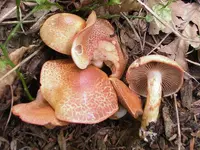
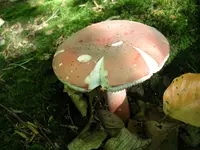
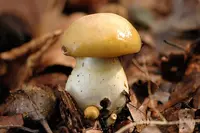
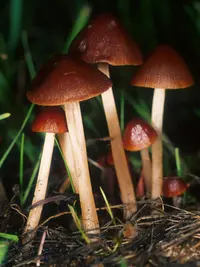
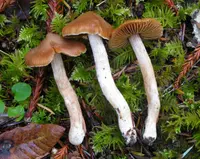
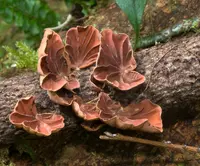
The dappled webcap, Cortinarius bolaris, is a woodland mushroom, not a houseplant. It forms small to medium caps with reddish to orange scales on a paler background, giving a speckled or dappled look. Slender stems and a delicate web-like veil are typical for this genus.
This fungus occurs mainly in temperate forests of Europe and parts of North America, often growing on the ground among leaf litter and moss near trees. It is not a practical species to cultivate at home, as it depends on complex partnerships with tree roots and specific soil fungi. For this reason, it is difficult to control or care for dappled webcap in garden or indoor settings.

Care Difficulty
Hard Care

Light Preference
Partial Shade

Water Requirements
Keep Soil Moist

Temperature Preference
Cool Climate

Hardiness Zone
Unknown

Soil Texture
Loamy, Silty, Organic-rich

Soil pH
Strongly acidic (4.5–5.5), Acidic (5.5–6.5)

Soil Drainage
Moist but well-drained

Fertilization
Minimal (feed rarely)
Scan your plant to receive care tips personalized for your specific plant
Available on iOS and Android
This ectomycorrhizal mushroom prefers cool, shaded woodland light conditions rather than direct sun exposure.
This forest fungus depends on evenly moist, well-drained soil around its tree partners rather than direct watering of the mushrooms.
This species develops best in cool to mild woodland temperatures typical of temperate forests.
Humidity control is not a meaningful factor for Cortinarius bolaris, which develops outdoors in natural forest conditions rather than in managed indoor environments.
Cortinarius bolaris occurs naturally in undisturbed forest soils, so it is not suited to typical garden or potting setups.
This species is not suitable for container growing, as it relies on complex mycorrhizal relationships with living forest trees that containers cannot provide.
This woodland fungus forms mycorrhizal partnerships with trees, so direct fertilization of Cortinarius bolaris is neither needed nor recommended.
Pruning is not applicable for Cortinarius bolaris, as it is a wild mycorrhizal mushroom rather than a horticultural plant with stems or branches.
This mycorrhizal fungus is not suited to container culture, so focus on maintaining suitable woodland conditions rather than repotting Cortinarius bolaris.
Intentional propagation of Cortinarius bolaris is rarely practical for home growers, as this fungus depends on complex mycorrhizal relationships with host trees.
No special winter care is required for this hardy woodland fungus, which survives as underground mycelium while fruiting bodies disappear.

Plant Health Check
Not sure what's wrong with your plant? Check your plant's health inside the app.
Its caps are orange to yellow with scattered bright red scales, giving a dappled appearance that makes it one of the more easily recognized members of the large Cortinarius genus in European woodlands.
This species forms ectomycorrhizal associations with both conifers and broadleaf trees, exchanging mineral nutrients from the soil for sugars from the host tree and contributing to forest nutrient cycling.
It is regarded as inedible and likely toxic, with reports of gastrointestinal symptoms after consumption, yet its exact toxin profile has not been fully characterized in modern chemical studies.
This fungus is considered poisonous and should never be eaten. It belongs to a difficult genus where many species are dangerously toxic. Identification is challenging, so all similar orange-red Cortinarius mushrooms should be treated as inedible.
Keep your plants happy and healthy with plant identification, disease detection, and easy care guidance.