Spore-friendly habitat
Leave some mature mushroom caps undisturbed on site so they can release spores and help maintain the local population rather than harvesting every fruiting body.

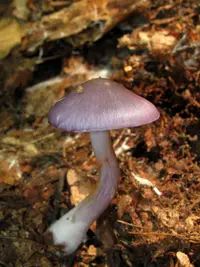
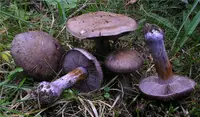
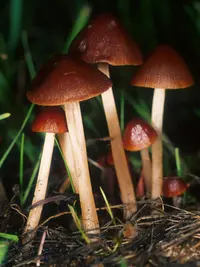
Viscid violet cort (Cortinarius iodes) is a woodland mushroom, not a true plant, known for its striking slimy violet cap and pale lilac gills. It forms mycorrhizal relationships, meaning it lives in close partnership with tree roots, especially hardwoods in eastern North America. Caps are small to medium, often bell-shaped when young, and grow in leaf litter on the forest floor, usually in scattered groups. This species is not suited to typical home cultivation because it depends on living trees and complex soil fungi communities. For most people, how to care for Viscid Violet Cort is mainly about habitat protection rather than trying to grow it indoors or in containers.

Care Difficulty
Hard Care

Light Preference
Partial Shade

Water Requirements
Keep Soil Moist

Temperature Preference
Cool Climate

Hardiness Zone
Unknown

Soil Texture
Loamy, Silty, Organic-rich

Soil pH
Acidic (5.5–6.5)

Soil Drainage
Moist but well-drained

Fertilization
Minimal (feed rarely)
Scan your plant to receive care tips personalized for your specific plant
Available on iOS and Android
This woodland mushroom prefers low, filtered light similar to a shaded forest floor when growing near its tree partners.
This ectomycorrhizal fungus depends on consistently moist, well-drained forest soil rather than direct watering of the fruiting bodies.
This species fruits best in cool to mild conditions that resemble natural temperate forests.
This woodland fungus requires consistently moist, high-humidity conditions around 70–90% to fruit reliably.
This ectomycorrhizal fungus grows in undisturbed, natural forest soil rather than prepared mixes.
This forest mushroom is not suitable for typical container growing because it relies on complex root partnerships in natural soil.
This wild ectomycorrhizal fungus does not need direct fertilization in cultivation or woodland gardens.
Pruning is not applicable to Cortinarius iodes, as it is a wild mushroom rather than a garden plant.
Transplanting is rarely successful because this fungus depends on a living tree root partnership to survive.
Practical propagation of this ectomycorrhizal fungus is unreliable for home growers and is not routinely attempted.
No specific winter care is needed; this species survives as underground mycelium and fruits again in suitable seasons.

Plant Health Check
Not sure what's wrong with your plant? Check your plant's health inside the app.
The caps and stems are coated in a thick, sticky slime layer when fresh, which helps trap moisture and gives the mushroom its common name viscid violet cort.
This species forms ectomycorrhizal associations with hardwoods such as birch and oak, exchanging soil nutrients and water for sugars produced by the tree through photosynthesis.
The vivid purple cap often fades toward brownish or duller tones as the fruiting body ages or dries, which can make older specimens harder to recognize in the field.

The violet pigments in this species are water-soluble and can visibly stain hands or collection containers when handled in wet conditions, a feature that field mycologists sometimes use as an additional identification clue.
This fungus is not considered edible and should be treated as poisonous. Some related Cortinarius species contain dangerous toxins that damage kidneys. For safety, do not eat it and avoid tasting or trial identification by eating.
Keep your plants happy and healthy with plant identification, disease detection, and easy care guidance.