Host tree selection
Establish the fungus near compatible host trees such as birch, spruce, or pine, and avoid areas dominated by non-mycorrhizal ornamentals or heavy turf so the mycelium can form stable symbiosis with the roots.

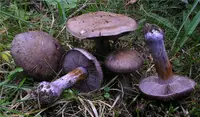
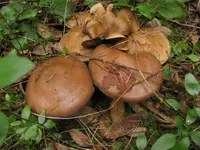
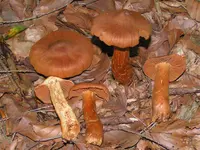
Cortinarius purpurascens, commonly called bruising webcap, is a woodland mushroom, not a typical houseplant. It forms fleshy, rounded caps that often stain purple when damaged, with a fibrous veil that creates a web-like pattern on young specimens. This fungus grows naturally in moist, shaded forests across parts of Europe and North America, usually in soil rich in leaf litter near trees. It is mycorrhizal, meaning it lives in close partnership with tree roots, which makes it very difficult to cultivate at home. Most growers do not attempt to care for bruising webcap, as it depends heavily on natural forest conditions and specific tree partners.

Care Difficulty
Hard Care

Light Preference
Partial Shade

Water Requirements
Keep Soil Moist

Temperature Preference
Cool Climate

Hardiness Zone
Unknown

Soil Texture
Loamy, Peaty, Organic-rich

Soil pH
Strongly acidic (4.5–5.5), Acidic (5.5–6.5)

Soil Drainage
Moist but well-drained

Fertilization
Minimal (feed rarely)
Scan your plant to receive care tips personalized for your specific plant
Available on iOS and Android
This ectomycorrhizal fungus prefers cool, shaded woodland light conditions rather than direct sun exposure.
This woodland fungus depends on stable, evenly moist soil rather than direct, frequent watering of the fruiting area.
This species fruits best in cool to mild conditions typical of late summer to autumn woodlands.
Humidity is not a major factor for this ectomycorrhizal fungus, which relies more on soil moisture and host trees than air humidity.
This mycorrhizal fungus requires a natural, mineral-rich forest soil rather than a standard potting mix.
This species is not suitable for container growing, because it depends on long-term ectomycorrhizal association with host tree roots in undisturbed soil.
Cortinarius purpurascens is a mycorrhizal woodland fungus that does not benefit from direct fertilization in gardens or containers.
Pruning is not applicable for Cortinarius purpurascens because it is a wild mycorrhizal mushroom rather than a landscape plant.
This species is not suited to typical repotting or transplanting because it depends on a stable mycorrhizal relationship with host tree roots.
Propagation of this bruising webcap in garden or indoor settings is not practical because it relies on complex, specific mycorrhizal partnerships with trees.
No special winter care is needed because Cortinarius purpurascens persists underground as mycelium and fruits seasonally when conditions suit it.

Plant Health Check
Not sure what's wrong with your plant? Check your plant's health inside the app.
The caps and gills of this species slowly turn dark purple to almost black when handled or damaged, a color change caused by oxidation of specific pigment compounds in the flesh.
This fungus forms ectomycorrhizal partnerships with conifers and birch in cool temperate and boreal forests of Europe and North America, exchanging mineral nutrients for sugars from its tree hosts.
Mature fruiting bodies can show a wide range of cap colors from brownish olive to reddish or violet tones, often with a sticky surface when moist, which can make field identification challenging among similar-looking webcaps.
This species is not considered edible and should be treated as poisonous. Some closely related Cortinarius species are deadly, and accurate identification is difficult. For safety, do not eat any part and avoid tasting raw material.
Keep your plants happy and healthy with plant identification, disease detection, and easy care guidance.