Mycorrhizal partner trees
Establish or retain a small stand of compatible host trees such as birch, spruce, or pine nearby, as this mycorrhizal fungus depends on living tree roots for carbon and will not persist in isolated substrate beds.

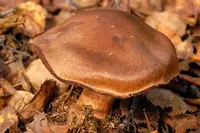
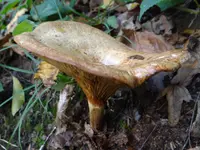
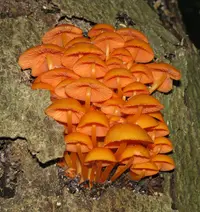
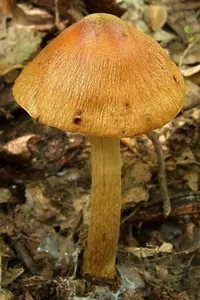
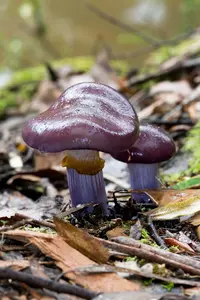
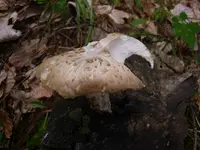
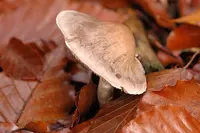
Cortinarius cinnamomeus, commonly called cinnamon webcap, is a small woodland mushroom rather than a traditional garden plant. It forms thin, cinnamon-brown caps with slender stems and a fine, cobweb-like veil under the cap in young specimens.
This species typically appears in damp, mossy coniferous forests across cooler regions of Europe, Asia, and North America. It grows on the ground, often in scattered groups, closely associated with tree roots.
Because it relies on a mycorrhizal partnership, where the fungus and tree roots exchange nutrients, it is not straightforward to cultivate intentionally. Gardeners generally do not care for cinnamon webcap directly but may encounter it naturally in suitable forest-like settings.

Care Difficulty
Hard Care

Light Preference
Partial Shade

Water Requirements
Keep Soil Moist

Temperature Preference
Cool Climate

Hardiness Zone
Unknown

Soil Texture
Loamy, Peaty, Organic-rich

Soil pH
Strongly acidic (4.5–5.5), Acidic (5.5–6.5)

Soil Drainage
Moist but well-drained

Fertilization
Minimal (feed rarely)
Scan your plant to receive care tips personalized for your specific plant
Available on iOS and Android
This forest fungus relies on low, filtered light rather than direct sun for proper development.
This mycorrhizal fungus depends on consistently moist, never waterlogged, forest soil.
This species favors cool to mild conditions typical of temperate woodlands.
This woodland fungus prefers consistently moist, cool air but relies more on soil moisture than on tight indoor-style humidity control.
This mycorrhizal fungus relies on moist, cool, organic-rich forest soil rather than standard potting mixes.
This species is not suitable for long-term container growing because it depends on complex mycorrhizal associations with tree roots in natural soil.
Cortinarius cinnamomeus is a wild mycorrhizal fungus that should not be fertilized directly in typical cultivation attempts.
Pruning is not applicable to Cortinarius cinnamomeus, since it is a wild mushroom forming seasonal fruiting bodies rather than a pruned plant.
This fungus is not suited to normal repotting or transplanting because it depends on living host tree roots in natural soil.
Propagation of Cortinarius cinnamomeus is specialized and rarely attempted outside research settings, as it relies on spores and specific tree partners.
No special winter care is required for this hardy woodland fungus, which overwinters as mycelium in the soil of its forest habitat.

Plant Health Check
Not sure what's wrong with your plant? Check your plant's health inside the app.
This species produces a rusty brown spore print that is typical for many Cortinarius fungi but has a characteristic warm cinnamon tone, which helped inspire its common name cinnamon webcap.
It is strongly associated with wet, acidic habitats such as boggy conifer forests and swampy spruce stands, and is often found among Sphagnum moss in northern and boreal regions.
The fungus forms ectomycorrhizal associations with the roots of conifers such as spruce and pine, exchanging mineral nutrients from the soil for sugars produced by the tree through photosynthesis.

The fruiting bodies of this species are frequently used as a reference example in mycological field guides to illustrate the classic "cortina" veiling structure, a fine cobweb-like partial veil that leaves distinct fibrils on the stem as the cap expands.
This mushroom is not edible and should be treated as poisonous. It can be confused with deadly Cortinarius species. Foraging is unsafe unless guided by an expert mycologist. Avoid tasting, chewing, or feeding it to anyone.
Keep your plants happy and healthy with plant identification, disease detection, and easy care guidance.