Use hardwood chunks
Place fresh, debarked hardwood branches or chunks on top of the main substrate to give the mycelium new, clean colonization surfaces and extend the fruiting period when growing orange mycena.

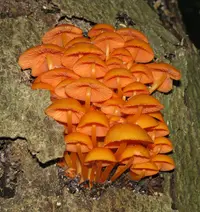
Orange mycena (Mycena leaiana) is a small, bright orange saprophytic fungus that feeds on decaying wood rather than living plants. It forms tight clusters of slim, bell-shaped caps on fallen logs and stumps, often creating vivid orange patches in shaded forests.
This species is native to North America and is most often found in moist hardwood forests with plenty of rotting branches. It is not suited to typical houseplant culture, and attempts to care for orange mycena at home are usually short-lived due to its specific wood-decay and humidity needs.

Care Difficulty
Hard Care

Light Preference
Shade

Water Requirements
Keep Soil Moist

Temperature Preference
Cool Climate

Hardiness Zone
Unknown

Soil Texture
Organic-rich, Peaty, Loamy

Soil pH
Strongly acidic (4.5–5.5), Acidic (5.5–6.5)

Soil Drainage
Moist but well-drained

Fertilization
Minimal (feed rarely)
Scan your plant to receive care tips personalized for your specific plant
Available on iOS and Android
This woodland fungus thrives in low, filtered light that mimics a shaded forest floor.
This species requires consistently moist, but not stagnant, conditions around its decaying wood substrate.
This fungus performs best in cool to mild conditions similar to a shaded, temperate forest.
This fungus prefers consistently moist, high-humidity conditions to fruit well.
This wood-decaying fungus does not use soil in the usual sense but can be supported in a prepared lignin-rich substrate.
This species can be maintained in containers only as a specialized culture on wood-based substrate, not as a conventional potted plant.
This wood-decaying fungus gains nutrients from its substrate and usually needs no supplemental fertilizer in cultivation.
Mycena leaiana does not need structured pruning, but spent fruiting bodies can be tidied for appearance and hygiene.
This fungus is usually grown on logs or sterilized woody substrates rather than in standard pots, so transplanting is minimal.
Propagation of Mycena leaiana is possible but requires clean technique and suitable woody substrates.
This woodland fungus is naturally cold hardy in its native range and usually needs no specific winter care outdoors.

Plant Health Check
Not sure what's wrong with your plant? Check your plant's health inside the app.
The vivid orange color of this fungus comes from carotenoid pigments, the same class of compounds that color carrots and autumn leaves, and it remains strikingly bright even in deep forest shade.
This species grows almost exclusively on decaying hardwood logs, especially beech and maple, where its fine mycelium helps break down lignin and cellulose, key structural components of wood.
Fresh caps are coated in a distinctly slimy layer called an ixocutis, a gelatinous surface tissue that can help the fruiting body resist drying out in fluctuating forest humidity.

Mycena leaiana is sometimes considered an indicator of relatively undisturbed, moist deciduous forests in parts of eastern North America, since it tends to appear where fallen logs are allowed to decompose naturally rather than being removed.
This fungus develops quickly once conditions are right. Small pins can appear within days after heavy rain, with clusters reaching visible, showy size in 3–7 days, then collapsing and decomposing soon afterward.
Keep your plants happy and healthy with plant identification, disease detection, and easy care guidance.