

Host tree choice
Select and maintain suitable ectomycorrhizal hosts such as birch, pine, or spruce, since this fungus depends on living tree roots rather than organic substrate like compost or wood chips.

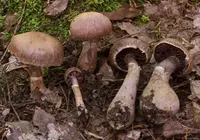
The stocking webcap, Cortinarius torvus, is a woodland mushroom rather than a typical houseplant. It forms sturdy, fleshy caps with pale to lilac tones and a thick, web-like veil on the stem. Fruiting bodies appear on the forest floor, usually in mossy or conifer-dominated habitats. It grows scattered or in small groups instead of dense clusters.
This species is native to temperate regions of the Northern Hemisphere, especially Europe and parts of North America. It forms mycorrhizal partnerships with trees, meaning it depends on living roots and does not adapt to container culture. Because of this specialized lifestyle, it is not suitable for home cultivation, and there is no practical way to care for stocking webcap indoors or in gardens.

Care Difficulty
Hard Care

Light Preference
Partial Shade

Water Requirements
Regular Water

Temperature Preference
Cool Climate

Hardiness Zone
Unknown

Soil Texture
Loamy, Silty, Organic-rich

Soil pH
Acidic (5.5–6.5)

Soil Drainage
Moist but well-drained

Fertilization
Minimal (feed rarely)
Scan your plant to receive care tips personalized for your specific plant
Available on iOS and Android
This mycorrhizal forest fungus prefers low to moderate light typical of shaded woodland floors.
This fungus depends on consistently moist, not waterlogged, forest soil around its host trees.
This temperate woodland species fruits best in cool to mild conditions typical of autumn forests.
This ectomycorrhizal mushroom requires consistently moist, cool air but not saturated conditions to fruit well.
This species fruits in forest soils rather than typical garden beds, so soil conditions must mimic its natural, organic woodland habitat.
This forest-dwelling ectomycorrhizal fungus is not suitable for container growing because it depends on complex root and soil interactions in open ground.
Cortinarius torvus is a wild mycorrhizal mushroom that does not require direct fertilization, as it obtains nutrients through its tree host.
Pruning is not applicable to Cortinarius torvus, because it is a forest mushroom rather than a woody or leafy plant.
Transplanting Cortinarius torvus is generally unsuccessful because this fungus depends on a stable mycorrhizal relationship with host tree roots in undisturbed soil.
Propagation of Cortinarius torvus is difficult and is not typically attempted outside specialized ecological or mycological work.
This mushroom is naturally cold hardy in its native range and needs no active winter care from a gardening perspective.

Plant Health Check
Not sure what's wrong with your plant? Check your plant's health inside the app.
This species forms ectomycorrhizal associations with birch trees, exchanging mineral nutrients from the soil for sugars from the host. It is most frequently recorded in moist, often boggy birch woodland and seems to show a clear preference for Betula species on acidic soils.
Its spores are relatively large, almond-shaped, and strongly verrucose, meaning they have coarse warts on the surface that are clearly visible under a microscope. This spore ornamentation is an important character used by mycologists to separate it from similar brown Cortinarius species.
The fruiting bodies appear mainly in late summer to autumn in cool, temperate to boreal climates, including subarctic regions. It is regularly documented from northern Europe and other high-latitude areas, indicating good adaptation to short growing seasons and cold conditions.
This species is considered inedible and potentially poisonous. It contains compounds that may damage the kidneys and other organs. Identification within the Cortinarius genus is difficult, so it should never be collected or eaten as food.
Keep your plants happy and healthy with plant identification, disease detection, and easy care guidance.

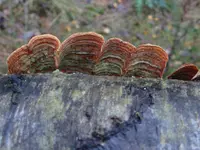
yellowing curtain crust
Stereum subtomentosum
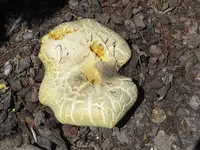
Golden Bolete
Buchwaldoboletus sphaerocephalus
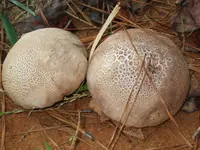
Purple-Spored Puffball
Calvatia cyathiformis
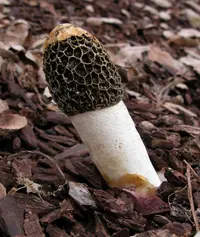
dune stinkhorn
Phallus hadriani
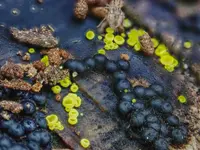
Sulphur Disco
Calycina claroflava
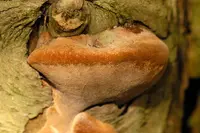
Cushion Bracket
Phellinus pomaceus
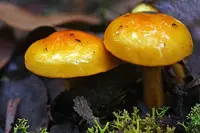
Cortinarius sinapicolor
Cortinarius sinapicolor
red edge bonnet
Mycena rubromarginata