

Choose proper substrate
Mount the fungus on well-decayed hardwood logs or thick bark slabs, avoiding conifers and freshly cut wood, to provide the stable lignin-rich substrate it needs for long-term colonization.

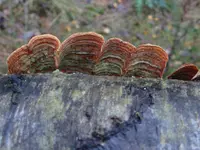
Yellowing curtain crust, Stereum subtomentosum, is a thin, crust-like bracket fungus rather than a leafy or stemmed plant. It forms wavy, overlapping bands on dead hardwood, with yellow to orange zones and a velvety surface when young.
This species is widely distributed in temperate forests, especially on fallen branches and logs of broadleaf trees. It plays an important role in wood decay, slowly breaking down dead timber.
Because it is a wood-inhabiting fungus with specialized needs, it is not easy to maintain in typical home conditions, and attempts to care for yellowing curtain crust indoors are rarely successful.

Care Difficulty
Moderate Care

Light Preference
Partial Shade

Water Requirements
Keep Soil Moist

Temperature Preference
Cool Climate

Hardiness Zone
Unknown

Soil Texture
Loamy, Silty, Organic-rich

Soil pH
Acidic (5.5–6.5), Slightly acidic (6.5–7.0)

Soil Drainage
Moist but well-drained

Fertilization
Minimal (feed rarely)
Scan your plant to receive care tips personalized for your specific plant
Available on iOS and Android
This wood-decay fungus favors low to moderate light, similar to shaded woodland conditions.
This species depends on consistently moist, but not waterlogged, wood rather than direct watering.
This fungus thrives in cool to mild conditions typical of temperate woodlands.
This wood-decaying fungus prefers consistently moist air but tolerates a broad humidity range outdoors.
This species grows on dead wood rather than soil, so focus on preparing a suitable lignin-rich substrate.
This bracket fungus can be maintained in containers when those containers are used to hold prepared wood substrates rather than soil.
This wood-decaying fungus usually gains all nutrients from its host and surrounding debris, so yellowing curtain crust does not need routine fertilization.
Pruning focuses on the host tree or log rather than Stereum subtomentosum itself, which naturally sheds old fruiting bodies.
This fungus is normally established on dead or dying wood, so transplanting focuses on moving colonized wood rather than handling roots.
Propagation of this bracket fungus is typically left to natural spore dispersal rather than managed methods.
This species is cold hardy in temperate climates and does not require dedicated winter protection when established on outdoor wood.

Plant Health Check
Not sure what's wrong with your plant? Check your plant's health inside the app.
This crust fungus causes white rot in hardwoods, selectively breaking down lignin while often leaving bleached, stringy cellulose behind, which changes wood structure and nutrient availability in forests.
Its thin, leathery brackets show clear concentric zones that can shift from yellow and orange when fresh to duller brown tones as they age or dry, aiding mycologists in field identification.
In many temperate regions it is most conspicuous in late autumn and winter on dead or fallen broadleaf branches, when other fungi are less visible and bark surfaces are easier to survey.

Molecular studies have shown that this species was often confused with other members of the Stereum hirsutum complex, and DNA sequencing helped clarify its status as a distinct taxon with its own characteristic morphology and ecological niche.
This bracket fungus is considered inedible due to its tough, leathery texture and lack of culinary value. It is not known to be dangerously poisonous, but it should not be collected or prepared as food.
Keep your plants happy and healthy with plant identification, disease detection, and easy care guidance.

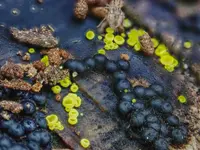
Sulphur Disco
Calycina claroflava
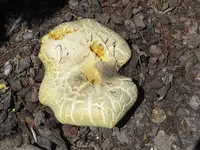
Golden Bolete
Buchwaldoboletus sphaerocephalus
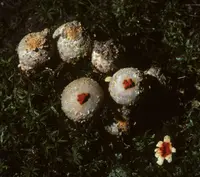
Calostoma ravenelii
Calostoma ravenelii
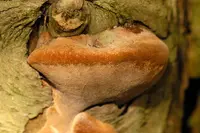
Cushion Bracket
Phellinus pomaceus
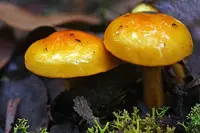
Cortinarius sinapicolor
Cortinarius sinapicolor
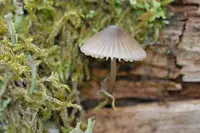
red edge bonnet
Mycena rubromarginata
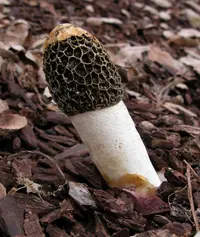
dune stinkhorn
Phallus hadriani
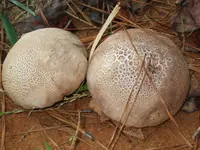
Purple-Spored Puffball
Calvatia cyathiformis