Spore safety protocol
Handle mature specimens outdoors or in a well-ventilated space and use gloves and, if disturbing gills, a simple dust mask to reduce contact with spores and unpleasant volatile compounds.

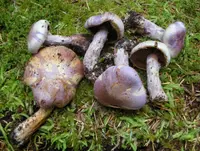
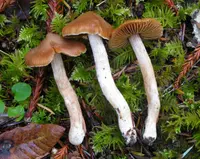
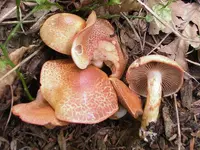
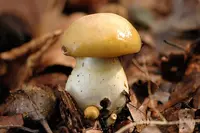
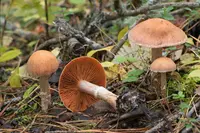
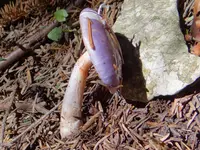
The gassy webcap, Cortinarius traganus, is a wild mushroom, not a houseplant. It grows from soil, usually in forests rather than gardens or containers. The cap is often lilac to brownish, with crowded gills and a thick stem, and it produces a strong, unpleasant odor. This scent is one of its key identification traits. Cortinarius traganus occurs mainly in coniferous and mixed woodlands in temperate regions, often forming mycorrhiza, a nutrient-exchanging partnership with tree roots. It is not a good candidate for home cultivation, as it depends on living trees and specific soil fungi communities. For that reason, there is very limited practical guidance on how to care for gassy webcap.

Care Difficulty
Hard Care

Light Preference
Partial Shade

Water Requirements
Regular Water

Temperature Preference
Cool Climate

Hardiness Zone
Unknown

Soil Texture
Loamy, Sandy, Organic-rich

Soil pH
Acidic (5.5–6.5)

Soil Drainage
Moist but well-drained

Fertilization
Minimal (feed rarely)
Scan your plant to receive care tips personalized for your specific plant
Available on iOS and Android
Cortinarius traganus is a mycorrhizal woodland fungus that fruits best under shaded, forest-like light conditions.
This forest fungus depends on naturally moist, well-drained soil rather than direct watering of the mushrooms.
This species fruits in cool to mild conditions typical of temperate forests.
Humidity is not a primary cultivation factor for Cortinarius traganus, which is rarely managed as a deliberate crop.
This ectomycorrhizal fungus depends on specific forest soil conditions rather than prepared mixes.
This species is not suitable for container growing, as it requires a living tree partner and natural forest soil conditions that containers cannot replicate.
Cortinarius traganus is a wild ectomycorrhizal fungus that should not be fertilized directly like a garden plant.
Pruning is not applicable to Cortinarius traganus, as it is a wild mushroom forming seasonal fruiting bodies rather than a pruned ornamental plant.
This fungus naturally associates with tree roots in soil and is not suited to standard repotting or transplanting.
Deliberate propagation of Cortinarius traganus is rarely attempted and is technically demanding due to its dependence on tree hosts.
Specific winter care is not required for Cortinarius traganus, which is adapted to natural outdoor seasonal cycles in its woodland habitat.

Plant Health Check
Not sure what's wrong with your plant? Check your plant's health inside the app.
The fruiting bodies emit an intense, unpleasant smell often compared to gas or rancid goat cheese, which helps distinguish it from many other violet-colored mushrooms in the field.
Although young caps and gills are lilac to violet, the gills gradually turn rusty-brown as the spores mature, a typical trait in the genus but particularly striking against the initially bright cap coloration in this species.
This fungus forms ectomycorrhizal associations with conifers, especially spruce and fir, exchanging mineral nutrients from the soil for sugars from the tree roots and contributing to nutrient cycling in cool, acidic forest habitats.

Cortinarius traganus is regarded as inedible and potentially poisonous, and its unusually foul odor is one reason it is sometimes cited in field guides as a classic example of a mushroom that should never be collected for the table.
This species is considered poisonous and should never be eaten. It has a strong, unpleasant odor and can cause serious gastrointestinal symptoms. Identification of wild mushrooms is difficult, so for safety, always avoid consuming it.
Keep your plants happy and healthy with plant identification, disease detection, and easy care guidance.