


Host tree selection
Establish the fungus near compatible host trees such as birch, oak, pine, or spruce, since this species relies on a mycorrhizal partnership with living roots rather than growing well in isolated beds or containers.

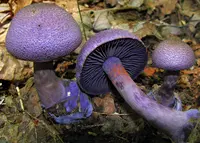
The violet webcap, Cortinarius violaceus, is a striking woodland mushroom, not a true plant, recognized by its deep violet cap, gills, and stem. It forms mycorrhiza, a nutrient-sharing partnership with tree roots, which makes it dependent on suitable host trees.
This species occurs mainly in temperate forests of Europe, North America, and parts of Asia, often near conifers or birch. Its reliance on specific forest conditions means it is not easy to cultivate and requires advanced knowledge to care for violet webcap.
In nature it prefers cool, moist, shaded habitats with undisturbed, humus-rich soil and good airflow.

Care Difficulty
Hard Care

Light Preference
Partial Shade

Water Requirements
Regular Water

Temperature Preference
Cool Climate

Hardiness Zone
Unknown

Soil Texture
Loamy, Silty, Organic-rich

Soil pH
Acidic (5.5–6.5)

Soil Drainage
Moist but well-drained

Fertilization
Minimal (feed rarely)
Scan your plant to receive care tips personalized for your specific plant
Available on iOS and Android
This forest mushroom relies on shaded woodland light rather than direct open-sun exposure.
This ectomycorrhizal fungus depends on stable, evenly moist forest soil rather than targeted watering like a potted plant.
This species prefers cool to mild woodland temperatures and does not tolerate hard environmental extremes.
This ectomycorrhizal mushroom relies on outdoor forest conditions, so humidity is managed by habitat rather than by direct adjustment.
This species depends on forming mycorrhizal partnerships in undisturbed forest ground rather than standard potting substrates.
This species is not suitable for true container culture, because it needs long-term association with living tree roots in the ground.
Cortinarius violaceus is a wild mycorrhizal fungus that normally does not need direct fertilization when grown in association with suitable host trees.
Cortinarius violaceus produces short-lived fruiting bodies, so there is no meaningful structural pruning in the gardening sense.
This fungus is best established outdoors with host trees, so focus on careful site preparation rather than frequent moving or repotting.
Propagation of Cortinarius violaceus in home settings is challenging and rarely attempted successfully.
Cortinarius violaceus is naturally cold hardy in its native climates and usually needs no special winter care once established in the ground.

Plant Health Check
Not sure what's wrong with your plant? Check your plant's health inside the app.
The entire fruiting body of this species, including cap, gills, stem, and even spore print, is a deep violet to purple-black, which is highly unusual among mushrooms and makes it visually distinctive in the field.
This fungus typically associates with mature or old-growth forests, forming ectomycorrhizal partnerships with trees such as birch, oak, spruce, and pine, and is often considered an indicator of relatively undisturbed woodland habitats.
Although recorded from North America, Europe, and parts of Asia, it is rarely encountered and often appears as isolated, scattered fruiting bodies rather than large clusters, which contributes to its reputation as a seldom-seen species.

The species has been the subject of taxonomic revision because some populations that look very similar have turned out to be distinct but closely related species, which means older field records of this mushroom may actually represent a complex of several violet Cortinarius species rather than a single, uniform taxon.
This mushroom is considered inedible or at best of very poor culinary value. Identification within the Cortinarius genus is difficult, and many relatives are dangerously toxic. For safety, it should not be collected or eaten.
Keep your plants happy and healthy with plant identification, disease detection, and easy care guidance.

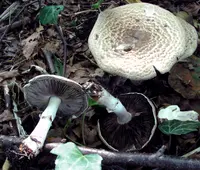
Tufted Wood Mushroom
Agaricus impudicus
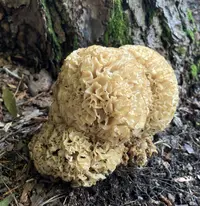
American cauliflower mushroom
Sparassis americana
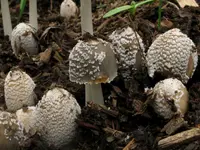
flocculose inkcap
Coprinellus flocculosus
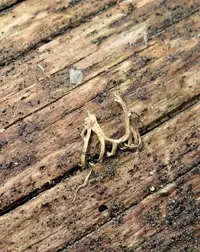
Artomyces cristatus
Artomyces cristatus
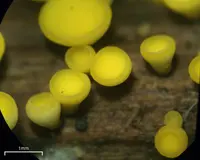
Yellow Fairy Cups
Bisporella citrina
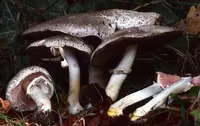
Inky Agaricus
Agaricus moelleri
Agrocybe acericola
Agrocybe acericola
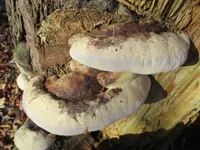
American Brown Fomitopsis
Fomitopsis ochracea