Mark Dormant Clumps
Place discreet markers where clumps grow before foliage dies back so you avoid disturbing the small tubers when digging, mulching, or planting later in the season.

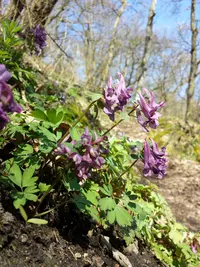
Spring fumewort (Corydalis solida) is a small, tuberous perennial that appears in very early spring and disappears again by early summer. It forms low clumps of finely divided, fern-like leaves topped with short spikes of tubular flowers in pink, purple, or white tones.
This woodland plant is native to parts of Europe and western Asia, where it grows in deciduous forests and light shade. It spreads slowly by tubers and self-seeding, creating naturalistic drifts when conditions suit it.
Once established, it is generally easy to care for spring fumewort if the soil stays moist in spring, drains well, and the plant receives light shade and undisturbed dormancy in summer.

Care Difficulty
Moderate Care

Light Preference
Partial Shade

Water Requirements
Moderate Water

Temperature Preference
Cold Hardy

Hardiness Zone
4–8

Soil Texture
Loamy, Silty, Organic-rich

Soil pH
Acidic (5.5–6.5), Slightly acidic (6.5–7.0)

Soil Drainage
Moist but well-drained

Fertilization
Minimal (feed rarely)
Scan your plant to receive care tips personalized for your specific plant
Available on iOS and Android
Corydalis solida prefers cool, mild light conditions that mimic an open woodland edge.
This bulb-like perennial needs steadily moist but not waterlogged soil during its short active season.
This species is adapted to cool spring conditions and a summer-dormant cycle.
This species prefers moderate humidity but usually copes well with typical indoor levels.
This tuberous woodland perennial needs loose, humus-rich soil that drains freely yet holds consistent moisture.
This species can be grown in containers if the pot supports cool, moist, but well-drained conditions for its tubers.
Corydalis solida is a small spring bulb that needs only light feeding in typical garden soil.
Corydalis solida needs minimal pruning, mainly cleanup after flowering.
This species is usually grown in the ground, so focus on occasional lifting and transplanting of the small tubers.
Corydalis solida is most commonly propagated by division of dormant tubers and, less often, by seed.
Corydalis solida is generally cold hardy in temperate climates and needs little specific winter care.

Plant Health Check
Not sure what's wrong with your plant? Check your plant's health inside the app.
This species survives summer as a small underground tuber and sends up leaves and flowers very early in spring, often completing most of its growth before surrounding trees fully leaf out.
Its seeds carry a fleshy oil-rich appendage called an elaiosome, which attracts ants; ants carry the seeds to their nests, eat the elaiosome, and leave the seeds to germinate in a new spot.
Flower color in this species ranges from purple and pink to almost white, and individual plants can show noticeable variation in shade depending on clone, soil, and light conditions, which has led to selection of many garden forms and cultivars.

The species is native to woodlands, scrub, and river valleys across central and eastern Europe into western Asia, where it often forms dense spring carpets that briefly dominate the forest floor before going completely dormant by early summer.
This species spreads slowly by small tubers and self-seeding, forming loose clumps rather than dense mats. In typical gardens it is not aggressive and is usually easy to control by lifting and thinning clumps if needed.
Keep your plants happy and healthy with plant identification, disease detection, and easy care guidance.