Wind-hardening young trees
Stake young trees only loosely and remove stakes after 1–2 years so the trunk can flex in the wind and develop strong taper, reducing future storm damage when growing Red-flowering gum.

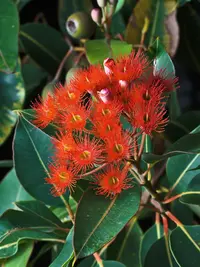
Red-flowering gum, Corymbia ficifolia, is a small to medium evergreen tree known for its dense canopy and striking clusters of red, pink, or orange blossoms. It typically develops a rounded crown and sturdy trunk, making it a strong visual feature in gardens and streetscapes.
This species is native to a limited coastal area of southwestern Western Australia, where it grows in well-drained, often sandy soils. In suitable climates it is relatively low-maintenance, though it can be sensitive to very cold or humid conditions.
Gardeners who care for Red-flowering gum should note its preference for full sun, good air circulation, and soil that does not stay waterlogged, which supports healthy flowering and growth.

Care Difficulty
Moderate Care

Light Preference
Full Sun

Water Requirements
Low Water

Temperature Preference
Tropical / Frost Sensitive

Hardiness Zone
9–11

Soil Texture
Sandy, Loamy, Rocky

Soil pH
Acidic (5.5–6.5), Slightly acidic (6.5–7.0)

Soil Drainage
Well-drained

Fertilization
Minimal (feed rarely)
Scan your plant to receive care tips personalized for your specific plant
Available on iOS and Android
This species thrives in open, bright locations with strong sun exposure.
This tree prefers deep, infrequent watering that encourages a strong root system.
This species favors mild, frost-free climates with warm, dry summers.
This species is generally tolerant of a wide humidity range and rarely needs special humidity management outdoors.
This species prefers well-structured, fast-draining mineral soils that prevent waterlogging around the roots.
This species can be grown in containers when young or kept dwarf with pruning, but needs careful pot choice for stability.
This species grows in low-nutrient soils, but moderate feeding improves flowering and canopy density in cultivated Red-flowering gum.
Pruning Corymbia ficifolia is mainly used to establish structure and maintain safe, healthy growth.
This tree is usually grown in the ground, so transplanting young plants correctly matters more than long-term repotting.
Propagation of Corymbia ficifolia is usually done from seed and can be slow and variable in home conditions.
Winter care depends strongly on climate, as this species is only moderately frost tolerant.

Plant Health Check
Not sure what's wrong with your plant? Check your plant's health inside the app.
In the wild, this species occurs naturally only in a small area of southwestern Western Australia, mainly near Walpole and Albany, making it one of the more geographically restricted eucalypts.
Its intense red, orange, or pink blossoms are rich in anthocyanins, pigment compounds that help attract bird pollinators and can vary subtly with genetics and growing conditions.
It is widely used as a parent in horticultural hybrids such as Corymbia 'Summer Red' and related cultivars, which combine its bright flowering with improved vigor or adaptability.

Unlike many eucalypts that grow into very tall forest trees, this species typically forms a relatively small, dense-headed tree with a broad, heavy canopy, making it one of the more compact flowering gums used as an ornamental street and garden tree in Mediterranean-climate regions.
Poor flowering usually comes from low light, excessive nitrogen fertilizer, drought stress, or a young tree that has not reached maturity. Stable conditions, moderate feeding, and patience are essential when growing Red-flowering gum for reliable blooms.
Keep your plants happy and healthy with plant identification, disease detection, and easy care guidance.