Structured formative pruning
In the first 3–5 years, lightly tip-prune leaders in late winter to build a strong, evenly spaced branch framework that will better resist wind and snow loads as the tree matures.

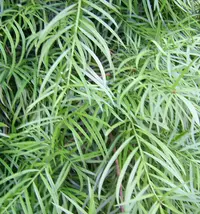
Willowleaf (Podocarpus salignus) is an evergreen conifer from Chile, valued for its narrow, willow-like leaves and neat, upright to softly weeping habit. It is usually grown as a small tree or large shrub in mild climates.
The foliage is glossy green and fairly dense, which makes it useful for screening, hedging, or a structural specimen in mixed plantings. Growth is moderate and generally tidy, so it often needs less pruning than many broadleaf shrubs.
In its native range, it occupies moist forest areas with cool, temperate conditions. Podocarpus salignus is considered reasonably easy if provided with good drainage, regular moisture, and protection from extreme heat or frost, making it straightforward to learn how to care for Willowleaf.

Care Difficulty
Moderate Care

Light Preference
Full Sun

Water Requirements
Moderate Water

Temperature Preference
Warm Climate

Hardiness Zone
8–10

Soil Texture
Sandy, Loamy, Organic-rich

Soil pH
Acidic (5.5–6.5), Slightly acidic (6.5–7.0)

Soil Drainage
Moist but well-drained

Fertilization
Minimal (feed rarely)
Scan your plant to receive care tips personalized for your specific plant
Available on iOS and Android
Podocarpus salignus prefers bright, cool conditions with some protection from intense midday sun.
Podocarpus salignus prefers evenly moist, well-drained soil that never stays waterlogged.
This species prefers mild, temperate conditions and does not tolerate severe freezing or extreme heat well.
Podocarpus salignus handles a wide humidity range but benefits from moderately moist air indoors.
Podocarpus salignus prefers slightly acidic, well-drained, structured soil that stays evenly moist without becoming waterlogged.
This species is well suited to container growing for patios, entrances, and small gardens.
Podocarpus salignus benefits from modest feeding to support steady growth, especially in containers.
Podocarpus salignus responds well to light, purposeful pruning that maintains structure and health.
This species is usually grown in the ground, but young or container-grown plants tolerate occasional repotting or transplanting if handled carefully.
Podocarpus salignus is commonly propagated from semi-ripe cuttings, with seed used mainly for larger-scale production.
This tree is moderately cold hardy but benefits from some winter care in colder or exposed sites.

Plant Health Check
Not sure what's wrong with your plant? Check your plant's health inside the app.
This species occurs naturally only in a limited range of central and southern Chile, where it grows in temperate rainforests with high rainfall and mild temperatures.
Unlike many conifers, it often forms a tall, narrow, columnar crown with relatively sparse branching, an adaptation that helps it compete for light in dense mixed forests.
Its long, narrow, willow-like leaves are atypical for a conifer and can remain on the tree for several years, giving it a distinctly broadleaf appearance despite being a gymnosperm.

In its native habitat, this species can exceed 20 m in height and develop a straight, clear trunk, which historically led to its selective logging for high-quality, fine-grained timber suitable for carpentry and boatbuilding.
Growth is moderate rather than fast. In good garden conditions, this species typically extends 20–30 cm per year, sometimes up to 40 cm when young. Growth slows with age and in containers or exposed, windy sites.
Keep your plants happy and healthy with plant identification, disease detection, and easy care guidance.