


cotoneaster Identification (Cotoneaster salicifolius)

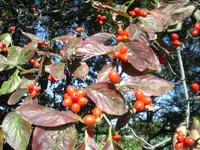
Recognize Cotoneaster salicifolius by its long, narrow, willow-like leaves, usually 2 to 4 inches (5 to 10 cm) long, set alternately along arching woody stems.

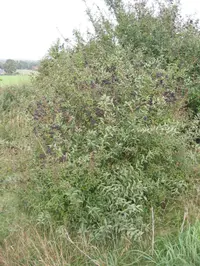
It typically forms a broad, fountain-shaped shrub, and the leaf undersides show a pale, felted surface that contrasts with the darker upper side.

Cotoneaster salicifolius Identification

Check Your Plant ID

Take or upload a photo to confirm your plant ID with Botan.

Clear images work best. Avoid photos taken too close or too far away

Use a few easy visual checks to assess Cotoneaster salicifolius.

  • Shrub is broad and arching, often with long, fountain-like branches.
  • Leaves are narrow and willow-like, usually about 2 to 4 inches (5 to 10 cm) long.
  • Leaf edges stay smooth, and the blades taper to a pointed tip.
  • Leaf undersides look paler than the upper surface and often show a slightly fuzzy texture.
  • Small round red berries hang along the stems and stand out against the foliage.

Check several branches, since the long narrow leaves and arching habit are the most useful clues.

Cotoneaster salicifolius shows clear stage-by-stage changes in shape, branching, flowers, and fruit display.

  • Young plant: Young plants are upright to arching, with longer extension shoots and relatively sparse side branching; leaves often look larger and more narrowly willow-like.
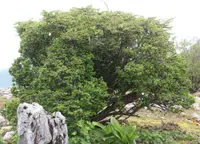
  • Mature plant: Mature plants form a broad, layered shrub, often 6-10 feet (1.8-3 m) tall, with dense branching and many short spur shoots carrying smaller leaves.
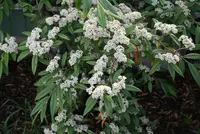
  • Flowering stage: At flowering, branch tips and short side shoots carry clusters of small white five-petaled flowers, shifting attention from foliage to a speckled, corymb-like display.
  • Fruiting stage: In fruit, the same clustered positions hold many rounded red pomes, making the branch framework easier to see because bright fruit outlines layered sprays.

Several cultivated forms of Cotoneaster salicifolius are distinct enough to separate by habit and leaf pattern.

  • 'Repens': A low, spreading form that usually stays under 2 feet (60 cm) tall while widening several feet, instead of making a tall arching shrub.
  • 'Rothschildianus': Best recognized by its pale yellow to creamy yellow berries rather than the usual bright red fruit.
  • 'Gnom': A dwarf, densely mounded plant, commonly around 2 to 3 feet (60 to 90 cm) tall, with shorter shoots and a tighter outline than the species.

In late spring to early summer, Cotoneaster salicifolius becomes easier to spot when clusters of small white flowers appear against its long, willow-like leaves. By fall, the flowers give way to abundant red berries that often persist into winter, creating one of the clearest seasonal identification clues. In colder areas, some leaves may drop, which can make the arching branch structure more visible.

A few shrubs are regularly mistaken for cotoneaster because of their narrow leaves, arching branches, and red fruit.

Parney cotoneaster(Cotoneaster lacteus)

Often confused because both are evergreen to semi-evergreen shrubs with arching sprays and clusters of red pomes. C. lacteus usually has broader, thicker leaves with a distinctly white-felted underside, while C. salicifolius has narrower willow-like leaves and less strikingly pale undersides.

Pyracantha(Pyracantha coccinea)

Confusion comes from similar red fruit and dense shrub form. Pyracantha is easiest to separate by its sharp thorns and shorter, broader leaves; Cotoneaster salicifolius lacks thorns and has longer, narrower leaves.

Cotoneaster salicifolius is native to western and central China. In the wild it is found on open mountain slopes, forest margins, scrub, and streamside thickets, often in upland districts. This helps with identification because it is a species associated with hilly to mountainous inland habitats rather than wetlands, deserts, or deep forest understory. Habitat context is most useful for separating it from unrelated broadleaf shrubs in similar landscapes.

  • Berries and seeds: The red fruit and seeds of Cotoneaster salicifolius are poisonous if eaten. This is an ingestion risk for humans and pets, especially children, dogs, and cats.
  • Leaves and stems: Leaves and stems also contain toxic compounds. Eating plant parts can cause illness in humans and pets, so fallen prunings and fruit are worth keeping out of reach.

Does Your Plant Match?

Use Botan to compare a photo and help confirm the plant, which can save time before buying, planting, or troubleshooting.

FAQ

This plant is a broad evergreen to semi-evergreen shrub with arching branches, narrow willow-like leaves, clusters of small white flowers, and bright red berries. In cotoneaster identification, the leaf shape and fruit display stand out.

More Plant Identification Guides

From Plant ID to Plant Info

Identify a plant from a photo with Botan, then review species-specific care information, safety notes, and common problems.

Botan app identifying a plant from a photo
Best Time to Mow Lawn – A Complete Guide

5 min read · 10 Aug 2026

Best Time to Mow Lawn – A Complete Guide

Explore when to mow your lawn for its health and a pleasant green color. Find out the best time for this task during the summer heat, and follow practical tips for correctly cutting the grass, and learn common mistakes to avoid.

Plant Care
Best Time to Mow Lawn – A Complete Guide
12 Best Plants That Repel Spiders For Your Home and Garden

8 min read · 24 Jul 2026

12 Best Plants That Repel Spiders For Your Home and Garden

Spiders constantly appear in places you don't want them. A few common plants can help repel them using scent alone. Here are 12 options suitable for both indoors and outdoors, plus care tips for each.

Plant Recommendations
12 Best Plants That Repel Spiders For Your Home and Garden
How to Clean Plant Leaves: A Simple Care Guide

6 min read · 4 Aug 2026

How to Clean Plant Leaves: A Simple Care Guide

Dusty leaves look dull and don't absorb light well. Below, you'll find simple ways to clean them, which tools are truly effective, how often you should do it, and what causes damage.

Beginner Guides
How to Clean Plant Leaves: A Simple Care Guide