

rhododendron Identification (Rhododendron ponticum)

Recognize Rhododendron ponticum by its dense, many-stemmed shrub form, leathery evergreen leaves held in whorls near shoot tips, and long, narrow leaf blades about 4 to 8 inches (10 to 20 cm) long.

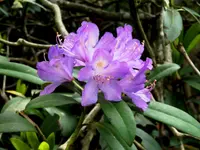
Its flowers are funnel-shaped with five lobes and appear in rounded terminal clusters at branch ends, a strong first-glance feature when present.

Rhododendron ponticum Identification

Identify a Plant by Photo

Upload a clear photo to check your plant identification with Botan.

Clear images work best. Avoid photos taken too close or too far away

Use these quick checks to assess Rhododendron ponticum by eye.

  • Usually a dense evergreen shrub or small tree with many stems rising from the base.
  • Leaves are simple, leathery, and narrowly oval to lance-shaped, about 4-8 inches (10-20 cm) long.
  • Leaves sit alternately along the stems and often cluster toward the shoot tips.
  • Flowers appear in rounded trusses, with several funnel-shaped blooms grouped tightly together.
  • Each flower typically has five lobes and is lilac-purple to pinkish purple, often with greenish spotting inside.

Check both the leaf shape and the clustered purple flowers for the clearest match.

Rhododendron ponticum shows useful visual changes from compact young growth to flowering shrubs.

  • Young plant: Young plants form a dense, low shrub with many thin shoots and relatively narrow evergreen leaves, giving a tighter outline than later stages.
  • Mature plant: Mature plants become broad, woody shrubs or small trees, often 6-15 feet (1.8-4.6 m) tall, with heavier branching and a more open framework.
  • Flowering stage: In flower, branch tips carry rounded clusters of lilac-purple, funnel-shaped blossoms that project beyond the foliage, making the crown look layered and less uniformly leafy.
  • Fruiting stage: After flowering, upright, elongated seed capsules replace the showy clusters, creating a drier, more angular appearance at the shoot ends.

In late spring to early summer, Rhododendron ponticum becomes much easier to spot when large clusters of purple to lilac funnel-shaped flowers open above the evergreen foliage. The bloom display is the clearest seasonal identification clue. After flowering, upright seed capsules develop and remain visible for a time. Because the leaves stay on through winter, the plant does not show a bare-stem season like deciduous shrubs.

A few broadleaf evergreens can be mistaken for rhododendron at a glance.

great laurel(Rhododendron maximum)

Similar because both are dense evergreen shrubs with long, leathery leaves and purple-toned flowers. Great laurel usually has larger leaves, often 4-8 inches (10-20 cm) long, and flower clusters are paler, commonly pink to white rather than deeper lilac.

mountain laurel(Kalmia latifolia)

Confusion happens when not in full bloom, since both are evergreen shrubs with leathery leaves. Mountain laurel has smaller leaves, usually 2-5 inches (5-13 cm), and distinctive cup-shaped flowers with angular buds, not the open funnel-shaped blooms of Rhododendron ponticum.

Rhododendron ponticum is native in two separated areas: the Iberian Peninsula in southwestern Europe and the Black Sea region, including parts of Turkey and the Caucasus. It is typically found in moist woodland, forest margins, and scrub, often in humid, shady settings from lowlands into montane zones. This helps with identification because a large evergreen rhododendron growing wild in damp woods within those regions is more likely to be R. ponticum than many alpine or open-site rhododendrons.

  • Poisonous parts: Rhododendron ponticum contains grayanotoxins. Leaves, flowers, nectar, and pollen are poisonous if eaten by humans and pets.
  • Honey risk: Honey made from its nectar can also contain grayanotoxins. This is an ingestion risk for humans.

Confirm It from a Photo

Use Botan to identify or verify a plant from an image when you need a quick second check before labeling it.

FAQ

Flowers are usually visible in spring, often from April into June depending on local climate. The blooms appear in showy terminal clusters, typically lilac to purple, which helps with identifying rhododendron in the field.

Everything About rhododendron

More Plant Identification Guides

Find the Plant. Get the Details.

Identify a plant from a photo with Botan, then see plant details, care information, and common problems.

Botan app identifying a plant from a photo
Best Bedroom Plants – Top 10 to Grow in Your Space

8 min read · 8 Jul 2026

Best Bedroom Plants – Top 10 to Grow in Your Space

Discover the top 10 houseplants that are suitable for growing in your bedroom. Compare their light and water needs, pet safety, and benefits. Find out where best to place greenery in your relaxation space and what species to avoid.

Plant Recommendations
Best Bedroom Plants – Top 10 to Grow in Your Space
Best Water for Plants – How to Choose the Right Type

7 min read · 13 Aug 2026

Best Water for Plants – How to Choose the Right Type

Rainwater, filtered, distilled, and tap water affect plants differently. Learn which types support healthy growth and which cause slow damage. Match each to your plants and discover how to easily improve tap water quality.

Plant Care
Best Water for Plants – How to Choose the Right Type
12 Most Wanted Rare Houseplants to Grow at Home

6 min read · 21 Sept 2026

12 Most Wanted Rare Houseplants to Grow at Home

Rare houseplants can turn an ordinary corner in your apartment into a living botanical collection. This guide covers 12 most admired picks, what makes them special, and how to grow them successfully at home.

Plant Recommendations
12 Most Wanted Rare Houseplants to Grow at Home