


Fan shape training
While stems are still flexible, loosely tie new shoots to horizontal or slightly angled wires or canes to create a fan-shaped framework that covers walls or banks evenly and reduces gaps in foliage later.

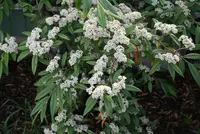
Cotoneaster salicifolius, often called willowleaf cotoneaster, is an evergreen to semi-evergreen shrub valued for its dense, arching branches and fine, narrow leaves. It forms ground-hugging mounds or low cascading hedges, often used on slopes, walls, and large borders.
Tiny white flowers appear in clusters, followed by bright red berries that persist into winter and attract birds. This species is native to western China but is widely planted in temperate landscapes.
It is generally robust and adaptable, tolerating a range of soils and urban conditions, which makes it relatively easy to care for cotoneaster. It prefers sun to light shade and moderately moist, well-drained soil for best appearance and berry production.

Care Difficulty
Easy Care

Light Preference
Full Sun

Water Requirements
Moderate Water

Temperature Preference
Cold Hardy

Hardiness Zone
5–8

Soil Texture
Sandy, Loamy, Clay

Soil pH
Slightly acidic (6.5–7.0), Slightly alkaline (7.0–7.5)

Soil Drainage
Well-drained

Fertilization
Minimal (feed rarely)
Scan your plant to receive care tips personalized for your specific plant
Available on iOS and Android
This shrub prefers bright outdoor conditions with several hours of direct sun for dense growth and flowers.
This plant prefers soil that dries slightly between waterings rather than staying constantly wet.
This hardy shrub tolerates a wide temperature range once established in the landscape.
Humidity is rarely a limiting factor for Cotoneaster salicifolius in typical outdoor conditions.
This shrub prefers well‑structured, freely draining soil that does not stay waterlogged.
This species is suitable for container growing, especially on patios or terraces.
This shrub appreciates modest feeding to support steady growth and berry production in average garden soil.
Thoughtful pruning keeps Cotoneaster salicifolius dense, healthy, and well-shaped.
This shrub is usually grown in the ground, so care focuses on thoughtful transplanting rather than frequent repotting.
Cotoneaster salicifolius is most commonly propagated from semi-ripe cuttings or by simple layering.
Mature plants are generally cold hardy and need little winter care in most temperate gardens.

Plant Health Check
Not sure what's wrong with your plant? Check your plant's health inside the app.
This species has long, narrow, glossy leaves that resemble those of willow trees and, unlike many other cotoneasters, it can remain evergreen or semi-evergreen in mild climates, keeping structure and greenery through winter.
Its small, bright red pomes persist into winter and are an important cold-season food source for birds such as thrushes and waxwings, which also help disperse the seeds over long distances.
Arching branches that touch soil can root naturally, a process called layering, which allows the plant to slowly expand into dense, ground-hugging thickets on banks and slopes.

In several regions including parts of the UK and New Zealand, Cotoneaster salicifolius is listed as an invasive or potentially invasive shrub because its bird-dispersed seeds and tolerance of poor, dry soils allow it to escape gardens and form dense stands that compete with native vegetation.
This species is typically evergreen or semi-evergreen in mild climates, holding narrow leaves through winter. In colder regions, it may drop part of its foliage, yet stems and structure remain, providing year-round landscape interest.
Keep your plants happy and healthy with plant identification, disease detection, and easy care guidance.


pink honeysuckle
Lonicera hispidula
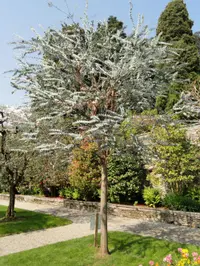
silver-leaved mountain gum
Eucalyptus pulverulenta

Persian ironwood
Parrotia persica
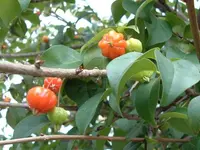
Surinam cherry
Eugenia uniflora

Acer palmatum var. dissectum
Acer palmatum var. dissectum

Acantholimon libanoticum
Acantholimon libanoticum
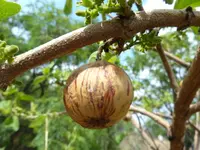
wild-medlar
Vangueria infausta

Red bearberry
Arctous rubra