Early structural training
In the first 3–5 years, select a single strong leader and remove competing stems or sharp-angled branches to build a stable trunk that can safely support the future heavy fruit load.

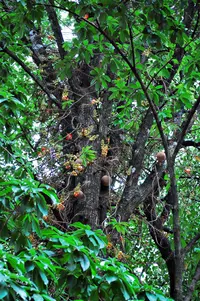
The cannonball tree, Couroupita guianensis, is a large tropical tree known for its heavy, round fruits and striking, fragrant flowers that grow directly on old wood. It is typically grown outdoors in warm, frost-free climates and develops a tall, spreading crown with a woody trunk.
This species is native to the tropical forests of northern South America but is now planted in botanical gardens and large landscapes in many tropical regions. It can be challenging outside the tropics, so learning how to care for cannonball tree is important before planting.
The tree prefers full sun, consistent moisture, and well-drained, fertile soil. Its size, climate needs, and heavy fruiting habit make it better suited to spacious outdoor sites than small gardens.

Care Difficulty
Hard Care

Light Preference
Full Sun

Water Requirements
Regular Water

Temperature Preference
Tropical / Frost Sensitive

Hardiness Zone
11–13

Soil Texture
Sandy, Loamy, Organic-rich

Soil pH
Acidic (5.5–6.5), Slightly acidic (6.5–7.0)

Soil Drainage
Moist but well-drained

Fertilization
Minimal (feed rarely)
Scan your plant to receive care tips personalized for your specific plant
Available on iOS and Android
Couroupita guianensis needs strong, tropical light to flower and fruit well.
This species prefers consistently moist, but not waterlogged, soil.
This tropical tree thrives in warm, frost-free climates.
This tropical tree prefers consistently high humidity and reacts poorly to very dry air.
Couroupita guianensis needs deep, airy soil that drains freely but does not dry out too fast.
This species can be grown in containers while young or dwarf, but roots demand careful space and stability management.
Nutrient-rich but well-drained soil supports healthy Couroupita guianensis growth, and moderate feeding improves flowering in cultivation.
Pruning Couroupita guianensis is mainly corrective, used to manage size, structure, and access under the canopy.
Couroupita guianensis is usually grown as a landscape tree, so transplanting young plants correctly is more important than frequent repotting.
Propagation of Couroupita guianensis is usually done from seed, with cuttings attempted less often.
This strictly tropical tree is very frost sensitive and needs careful winter management in cooler climates.

Plant Health Check
Not sure what's wrong with your plant? Check your plant's health inside the app.
The tree produces large, heavy, spherical fruits that fall and break open on impact, exposing a pulp that smells unpleasant to humans but attracts animals that help disperse the seeds.
Its strongly scented, complex flowers are structured to favor pollination by specific bees, which contact the pollen-bearing structures while searching for nectar on the curved staminal hood.
Flowers and fruits emerge directly from the trunk and main branches rather than from outer twigs, a trait called cauliflory that allows easier access for large pollinators and ground-dwelling seed dispersers.

The flowers of this species are highly fragrant and visually striking, which has led to its planting near temples and sacred sites in parts of South and Southeast Asia, where it is sometimes symbolically associated with religious and cultural traditions despite being native to tropical South America.
Growth is moderate in warm, humid climates, often adding 30–90 cm per year once established. Young trees may grow faster, then slow as the canopy develops. Poor drainage, cool temperatures, or nutrient deficiencies reduce growth rate.
Keep your plants happy and healthy with plant identification, disease detection, and easy care guidance.