Rotate For Symmetry
Turn the pot 90° every 2–3 weeks so all sides receive similar light, which keeps the leaf columns compact and prevents the plant from leaning toward the brightest side.

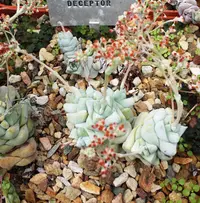
Crassula deceptor is a compact, slow-growing succulent native to arid regions of South Africa and Namibia. It forms tight, stacked columns of thick, gray-green leaves that resemble small geometric towers.
This species stays small and architectural, making it suitable for windowsills, containers, and rock garden displays in mild climates. Its thick leaves store water, which helps it tolerate neglect and irregular watering but also makes it sensitive to overwatering.
Light, porous soil and bright, indirect to full sun conditions support healthy growth. Understanding how to care for Crassula deceptor mainly involves balancing strong light with careful watering and excellent drainage.

Care Difficulty
Easy Care

Light Preference
Full Sun

Water Requirements
Low Water

Temperature Preference
Tropical / Frost Sensitive

Hardiness Zone
10–11

Soil Texture
Sandy, Loamy, Rocky

Soil pH
Slightly acidic (6.5–7.0), Neutral (7.0)

Soil Drainage
Well-drained

Fertilization
Minimal (feed rarely)
Scan your plant to receive care tips personalized for your specific plant
Available on iOS and Android
This compact succulent needs bright light with some protection from harsh midday sun.
This species stores water in its leaves and prefers thorough but infrequent watering.
This succulent prefers warm, dry conditions and is sensitive to prolonged cold and frost.
This compact succulent prefers dry indoor air and does not need added humidity.
Use a very fast-draining, mineral-based mix to prevent root rot in this species.
This slow-growing succulent is well suited to container culture.
This compact succulent needs only light feeding to stay healthy in containers.
Pruning is minimal and mainly used to maintain shape and remove weak growth.
This slow-growing succulent prefers tight quarters and infrequent repotting.
Propagation is commonly done from offsets and stem or leaf cuttings.
This species is not frost hardy and needs protection in cold climates.

Plant Health Check
Not sure what's wrong with your plant? Check your plant's health inside the app.
This species forms tight vertical columns of opposite leaves, with each new pair stacked directly above the previous one, creating a geometric, almost architectural growth form that is unusual even among Crassula species.
In habitat, C. deceptor often grows among pale quartz and gravel, and its blue‑grey, waxy leaf surface helps it blend into the stony background, reducing visibility to herbivores and limiting heat absorption.
The leaves carry a noticeable glaucous (bluish, waxy) bloom that scatters intense sunlight and slows water loss, an adaptation linked to its origin in arid, high‑light regions of South Africa and Namibia.
This species blooms sporadically and usually only when mature. Lack of flowers often relates to insufficient seasonal light, no cool, dry winter rest, or stress from repotting. Stable conditions over several years usually increase flowering chances.
Keep your plants happy and healthy with plant identification, disease detection, and easy care guidance.