Clay pot choice
Use an unglazed clay pot with several drainage holes to increase evaporation from the root zone and reduce the risk of root rot in this compact, fine-rooted succulent.

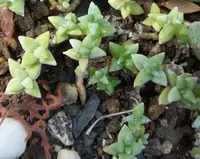
Silver-beads (Crassula deltoidea) is a compact succulent native to arid regions of South Africa and Namibia. It forms low, branching clumps with small, triangular leaves covered in a fine, silvery fuzz.
This leaf coating helps reduce water loss and gives the plant its distinctive beaded, gray-white appearance. In good conditions, it can produce small, clustered white flowers.
The species grows slowly and stays relatively small, which suits windowsills and small indoor collections. Its drought tolerance and modest size make it easier to care for Silver-beads than many leafy houseplants, provided it gets bright light, a fast-draining soil, and careful watering.

Care Difficulty
Easy Care

Light Preference
Full Sun

Water Requirements
Low Water

Temperature Preference
Tropical / Frost Sensitive

Hardiness Zone
10–11

Soil Texture
Sandy, Loamy, Rocky

Soil pH
Slightly acidic (6.5–7.0), Neutral (7.0)

Soil Drainage
Well-drained

Fertilization
Minimal (feed rarely)
Scan your plant to receive care tips personalized for your specific plant
Available on iOS and Android
Crassula deltoidea prefers bright, dry light similar to its native arid habitats.
Crassula deltoidea is a drought-tolerant succulent that stores water in its leaves and stems.
This succulent prefers warm, dry conditions and dislikes prolonged cold or damp.
Humidity is rarely critical for this drought-adapted succulent if airflow and watering are managed well.
This succulent needs a very fast-draining, mineral-based mix that prevents waterlogging around the roots.
This species is well suited to container growing when the pot supports fast drainage and a shallow root zone.
Crassula deltoidea has modest nutrient needs, so use light, infrequent feeding during active growth only.
Crassula deltoidea benefits from occasional light pruning to keep a compact, healthy form.
This compact succulent prefers slightly tight conditions and only needs infrequent repotting.
Crassula deltoidea is commonly propagated from stem or leaf cuttings under warm, bright, dry-leaning conditions.
This succulent is frost-sensitive and needs protection from freezing conditions in most climates.

Plant Health Check
Not sure what's wrong with your plant? Check your plant's health inside the app.
In its native habitat of the arid Western Cape of South Africa, this species grows among quartz and stony gravel, and its small, grey-green, bead-like leaves closely match the surrounding pebbles, helping it avoid herbivores and excess sun exposure.
The leaves are covered in fine papillae, which are tiny, nipple-like surface bumps that scatter intense light, reduce water loss, and give the plant its characteristic frosted, granular texture.
This succulent is adapted to the cool, winter-rainfall climate of the South African Cape, growing mainly during the mild, moist season and resting through the hot, dry summer, a pattern that differs from many succulents from summer-rainfall regions.

This species was historically described from highly localized quartz fields in South Africa, and some of its naturally occurring forms are now considered of conservation concern because their restricted microhabitats are vulnerable to disturbance and collection.
Slow growth is normal for this compact succulent, especially in low light, cool temperatures, or small pots. Limited nutrients, recent repotting, or winter dormancy also reduce growth. Patience and stable conditions are key when growing Silver-beads.
Keep your plants happy and healthy with plant identification, disease detection, and easy care guidance.