Rotate For Symmetry
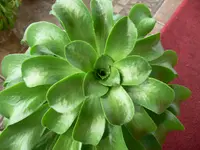
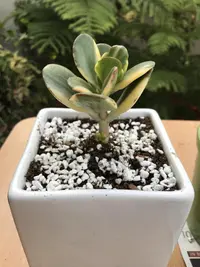
Turn the pot 90° every 2–3 weeks so new leaf pairs stack evenly and the plant does not lean or twist toward the light source.

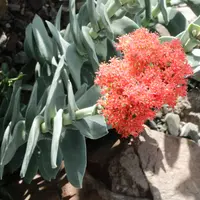
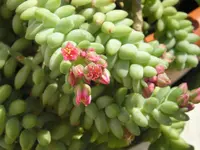
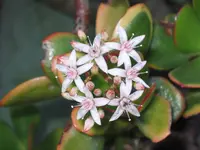
Red treasure (Crassula perfoliata) is a compact succulent shrub known for its stacked, narrow leaves and showy clusters of red tubular flowers. It forms a low, architectural mound that suits containers and bright indoor spots.
This species is native to arid regions of South Africa, where it has adapted to strong sun, quick-draining soils, and infrequent rainfall. Its drought tolerance and slow, tidy growth make it relatively straightforward for patient growers.
Those who care for Red treasure usually appreciate that it prefers bright light, lean gritty soil, and careful watering that lets the roots dry slightly between drinks.

Care Difficulty
Easy Care

Light Preference
Full Sun

Water Requirements
Low Water

Temperature Preference
Tropical / Frost Sensitive

Hardiness Zone
10–11

Soil Texture
Sandy, Loamy, Rocky

Soil pH
Slightly acidic (6.5–7.0), Neutral (7.0)

Soil Drainage
Well-drained

Fertilization
Minimal (feed rarely)
Scan your plant to receive care tips personalized for your specific plant
Available on iOS and Android
This succulent favors bright, direct light but needs gradual acclimation to strong sun.
Water deeply but infrequently, letting the plant dry well between soakings.
This species prefers warm, dry conditions and does poorly in frost.
This species handles typical indoor humidity well and rarely needs special humidity management.
Crassula perfoliata prefers a very free-draining, mineral-rich substrate to prevent root rot.
This succulent is well suited to container growing.
Crassula perfoliata benefits from light, controlled feeding during its active growing season.
Pruning Crassula perfoliata is mainly used to maintain shape, remove damaged growth, and encourage branching.
This succulent prefers slightly tight conditions, so repotting is infrequent but still useful over time.
Crassula perfoliata is commonly propagated from stem cuttings, which root well in the right conditions.
This succulent is frost sensitive and needs careful winter management in most temperate climates.

Plant Health Check
Not sure what's wrong with your plant? Check your plant's health inside the app.
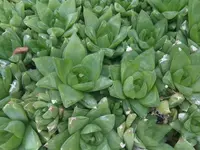
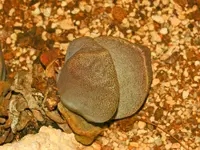
This species shows striking leaf variation across its subspecies, from long, narrow, sickle-shaped leaves in subsp. perfoliata to thick, triangular, boat-shaped leaves in subsp. falcata, all within the same species complex.
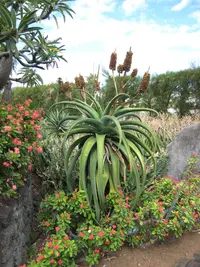
Wild populations often grow on rocky slopes and cliffs in South Africa and neighboring regions, where roots anchor into narrow crevices and the plant relies on excellent drainage and intense light.
In its native habitat it grows mainly during cooler, slightly wetter periods and slows down in the hottest, driest months, a pattern that reflects its adaptation to a semi-arid, winter-rainfall climate.

Crassula perfoliata and its close relatives were historically split and reclassified several times, and some forms now placed under this species were once described as separate species such as Crassula falcata, reflecting how morphologically diverse and taxonomically complex this single species is.
Flowering is reduced by low light, frequent watering, excess nitrogen, or a pot that is too large. Provide strong light, allow soil to dry more between waterings, and avoid high-nitrogen fertilizer to support bud formation.
Keep your plants happy and healthy with plant identification, disease detection, and easy care guidance.