Spore-Rich Mulch
After a good flush, leave some mature fruiting bodies to decay in place so their spores can enrich the surrounding leaf litter and support future colonies when growing Horn-of-plenty.

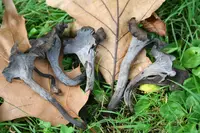
Horn-of-plenty, Craterellus cornucopioides, is a wild, funnel-shaped mushroom, not a leafy plant. It forms thin, trumpet-like fruiting bodies in dark gray to black tones. Clumps often blend into forest leaf litter, making them hard to spot. They typically appear in mixed or deciduous woodlands, especially near broadleaf trees like beech and oak in temperate regions. This species is mycorrhizal, meaning it forms a symbiotic partnership with tree roots, which makes it difficult to cultivate at home. For most growers, it is more realistic to forage responsibly than to care for Horn-of-plenty in cultivation.

Care Difficulty
Hard Care

Light Preference
Shade

Water Requirements
Keep Soil Moist

Temperature Preference
Cool Climate

Hardiness Zone
5–9

Soil Texture
Loamy, Silty, Organic-rich

Soil pH
Acidic (5.5–6.5)

Soil Drainage
Moist but well-drained

Fertilization
Minimal (feed rarely)
Scan your plant to receive care tips personalized for your specific plant
Available on iOS and Android
This woodland mushroom prefers low to moderate light that mimics a shaded forest floor.
This fungus needs consistently moist, not waterlogged, conditions in a loose, well-drained forest-type substrate.
This species fruits best in cool to mild conditions typical of temperate woodlands.
Craterellus cornucopioides needs consistently moist, humid conditions to fruit well, so humidity management is important.
Craterellus cornucopioides thrives in loose, humus-rich, well-drained substrate that mimics a forest floor.
This species is generally unsuitable for casual container growing, as it depends on complex woodland or mycorrhizal relationships that are hard to reproduce in pots.
This mycorrhizal fungus usually performs well without added fertilizer when grown in suitable woodland soil.
Craterellus cornucopioides does not require true pruning; only minimal cleanup is useful after fruiting.
This species is rarely grown in containers; management focuses on establishing and maintaining outdoor woodland patches.
Effective propagation of Craterellus cornucopioides is challenging, as it depends on mycorrhizal partnership with host tree roots.
In suitable climates this woodland fungus is cold hardy and usually needs no special winter care.

Plant Health Check
Not sure what's wrong with your plant? Check your plant's health inside the app.
The fruiting bodies are naturally dark gray to black because they contain high concentrations of melanins, pigments that help protect the tissue from light and environmental stress while giving the mushrooms their characteristic soot-like color.
This species forms ectomycorrhizal associations with tree roots, especially beech and oak, exchanging mineral nutrients and water for sugars from the host tree and contributing to forest soil health and nutrient cycling.
Fresh specimens have a relatively mild smell, but when dried they develop an intense, truffle-like, fruity aroma due to concentration and transformation of volatile organic compounds during dehydration.

In parts of Europe, this species is so strongly associated with All Saints’ Day and late-autumn foraging that its common name in several languages refers directly to the “trumpet of the dead,” reflecting its peak fruiting around that cultural and seasonal period.
This species is a well-known edible wild mushroom, valued for its rich, smoky flavor. It must be correctly identified, carefully cleaned, and thoroughly cooked. As with any wild fungi, beginners should consult an experienced forager or mycologist.
Keep your plants happy and healthy with plant identification, disease detection, and easy care guidance.