Host tree selection
Establish this mycorrhizal fungus near compatible hardwoods such as oaks, beeches, or birches, since it relies on their root systems rather than growing well in isolated mushroom beds.

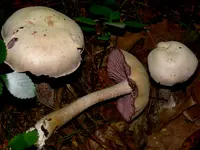
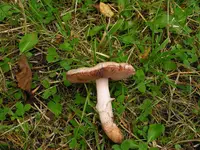
Purple-and-white deceiver, Laccaria ochropurpurea, is a woodland mushroom rather than a leafy houseplant. It produces sturdy, pale to deep purple caps with thick, widely spaced gills and a fibrous stem, often forming loose groups on the forest floor.
This species naturally occurs in mixed hardwood and conifer forests of North America, where it grows on soil rich in leaf litter and organic matter. It forms a mycorrhizal relationship, a mutually beneficial partnership, with tree roots, which makes it difficult to cultivate at home.
Those who want to learn how to care for Purple-and-White Deceiver should know it is better observed in its natural habitat than actively grown in containers or garden beds.

Care Difficulty
Moderate Care

Light Preference
Partial Shade

Water Requirements
Regular Water

Temperature Preference
Cool Climate

Hardiness Zone
4–8

Soil Texture
Loamy, Silty, Organic-rich

Soil pH
Acidic (5.5–6.5), Slightly acidic (6.5–7.0)

Soil Drainage
Moist but well-drained

Fertilization
Minimal (feed rarely)
Scan your plant to receive care tips personalized for your specific plant
Available on iOS and Android
This mycorrhizal mushroom prefers dappled woodland light that mimics a deciduous forest floor.
This woodland fungus depends on consistently moist, not saturated, soil around its host trees.
This species fruits best in cool to mild conditions typical of temperate woodlands.
Humidity is not a key factor for Laccaria ochropurpurea, which is adapted to outdoor woodland conditions rather than controlled indoor environments.
This ectomycorrhizal fungus prefers undisturbed, naturally structured forest soil rather than artificial potting mixes.
This species is generally unsuitable for container growing because it relies on a long-term partnership with tree roots in open soil.
Laccaria ochropurpurea is a mycorrhizal fungus that generally does not need direct fertilization when growing in suitable, undisturbed soil.
Laccaria ochropurpurea does not require pruning, as each mushroom is a short-lived fruiting body that naturally decays and recycles nutrients.
Transplanting Laccaria ochropurpurea focuses on moving its mycelium and host plants rather than the mushrooms themselves.
Propagation of this wild mycorrhizal fungus is challenging and rarely done intentionally by home growers.
This woodland fungus is naturally cold hardy in its native range and needs no special winter protection in the ground.

Plant Health Check
Not sure what's wrong with your plant? Check your plant's health inside the app.
This species shows a striking color shift as it matures, with young caps often dull yellow-brown that later develop richer purple-brown tones, which is unusual among North American Laccaria species and helps in field identification.
It forms ectomycorrhizal associations with hardwood trees such as oaks, creating a sheath around fine roots that improves tree nutrient and water uptake while receiving sugars produced by the host through photosynthesis.
The mushroom has a characteristically thick, tough, fibrous stipe (stem) that can be noticeably more robust than that of related Laccaria species, helping it withstand disturbances in leaf litter and compacted forest soils.
This species is generally regarded as edible but is not highly valued, and identification errors are risky. Some similar small purple mushrooms are poisonous. For safety, only experienced foragers should consume wild specimens, and never eat unknown fungi.
Keep your plants happy and healthy with plant identification, disease detection, and easy care guidance.