Log selection
Use freshly cut, disease-free logs from conifers such as spruce, fir, or hemlock, 10–20 cm in diameter, since this species establishes far more reliably on sound, uncolonized wood than on old, partially decayed logs.

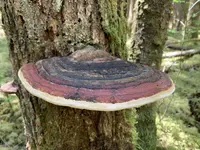
The northern red belt, Fomitopsis mounceae, is a perennial bracket fungus rather than a leafy houseplant. It forms hard, shelf-like fruiting bodies on dead or stressed conifer wood, with distinct red to chestnut bands and a pale edge. These woody brackets persist for several years and gradually expand in layers, giving trunks and stumps a tiered appearance.
In nature, it is common in colder forests of North America, especially in boreal and montane regions. It acts as a decomposer, breaking down wood and contributing to forest nutrient cycles. Because it depends on specific host trees and decay conditions, it is not easy to cultivate intentionally, and most people only need to know how to care for Northern Red Belt in managed woodland or naturalistic settings.

Care Difficulty
Moderate Care

Light Preference
Partial Shade

Water Requirements
Keep Soil Moist

Temperature Preference
Cool Climate

Hardiness Zone
Unknown

Soil Texture
Organic-rich, Loamy

Soil pH
Acidic (5.5–6.5)

Soil Drainage
Moist but well-drained

Fertilization
Minimal (feed rarely)
Scan your plant to receive care tips personalized for your specific plant
Available on iOS and Android
This wood-decaying bracket fungus prefers stable, cool forest light rather than direct sun exposure.
This fungus relies on consistent wood moisture rather than surface watering like a typical potted plant.
This species is adapted to cool to mild forest climates with significant cold tolerance.
Humidity plays a minor role because this wood-decay fungus naturally tolerates a broad moisture range on logs.
This fungus grows on dead conifer wood rather than in mineral soil, so focus on preparing the woody substrate.
This species is not naturally suited to standard container culture, but it can be managed in specialized buckets or tubs holding inoculated wood or sawdust blocks.
This wood-decay fungus grows on nutrient-rich trees and typically does not benefit from supplemental fertilization in cultivation.
Pruning is generally not applicable for Fomitopsis mounceae, as it is a bracket fungus forming hard, woody conks on trees rather than a conventional garden plant.
In gardens or culture, Northern Red Belt is usually established on woody substrates rather than grown in pots, so focus on correct placement rather than frequent transplanting.
Propagation of Fomitopsis mounceae is specialized and usually managed by experienced growers or researchers rather than casual home cultivation.
This species is naturally cold hardy in temperate forests and requires no special winter care in outdoor settings.

Plant Health Check
Not sure what's wrong with your plant? Check your plant's health inside the app.
Long treated as part of the red-belted conk complex, this species was only formally described in 2019 based on DNA evidence that separated it from look-alike relatives such as Fomitopsis pinicola.
It is strongly associated with cooler boreal and montane conifer forests in North America, especially on dead or dying trunks and logs of spruces and other cold-adapted conifers.
This fungus performs brown-rot, preferentially breaking down cellulose and hemicellulose in wood and leaving behind modified lignin, which contributes to coarse woody debris and long-term carbon storage in forest soils.

Molecular phylogenetic studies show that this species forms a distinct North American lineage within the Fomitopsis pinicola complex, illustrating how DNA sequencing can reveal hidden species diversity in what was once thought to be a single widespread red-belted bracket fungus.
Growth is moderate. New brackets usually appear or expand each year, adding 0.5–2 cm in thickness annually. Rate depends on host tree species, wood moisture, temperature, and how advanced the internal decay already is.
Keep your plants happy and healthy with plant identification, disease detection, and easy care guidance.