


Use hardwood blocks
For reliable fruiting, inoculate small, freshly cut hardwood blocks (5–10 cm) rather than loose chips, as solid wood holds moisture and nutrients more consistently over multiple flushes.

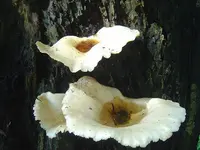
Flat crep (Crepidotus applanatus) is a small, saprophytic fungus that grows on decaying hardwood, not a typical houseplant. It forms thin, fan-shaped caps that sit flat against logs or branches, often overlapping in crowded tiers. The caps are usually pale cream to light brown, with a smooth to slightly velvety surface.
This species occurs widely in temperate forests of North America and Europe, especially in damp, shaded woodland. It is not commonly cultivated, as it relies on natural wood decay and specific moisture conditions. Those who wish to care for Flat Crep should understand it behaves more like a wild decomposer than a decorative indoor specimen.

Care Difficulty
Moderate Care

Light Preference
Shade

Water Requirements
Keep Soil Moist

Temperature Preference
Cool Climate

Hardiness Zone
Unknown

Soil Texture
Loamy, Silty, Organic-rich

Soil pH
Acidic (5.5–6.5), Slightly acidic (6.5–7.0)

Soil Drainage
Moist but well-drained

Fertilization
Minimal (feed rarely)
Scan your plant to receive care tips personalized for your specific plant
Available on iOS and Android
This wood-inhabiting fungus prefers low, filtered light similar to a shaded forest floor.
This fungus needs consistently moist, not saturated, conditions around its woody substrate.
This species develops best in cool to mild conditions typical of shaded woodland environments.
This wood-inhabiting fungus develops normally in typical outdoor humidity levels and does not demand special moisture control.
This saprotrophic fungus grows on decaying wood rather than mineral soil, so conditions must mimic rotting hardwood rather than a standard potting substrate.
Crepidotus applanatus can be grown in containers only if a piece of colonized, decaying hardwood is used as the main substrate rather than soil.
Crepidotus applanatus is a saprophytic fungus that gains nutrients from decaying wood and generally does not need additional fertilizer in cultivation.
Pruning is not a standard practice for Crepidotus applanatus, since its fruiting bodies are short-lived fungal structures rather than persistent plant shoots or branches.
When grown for observation on wood blocks or in culture, this fungus is rarely moved, but some care helps limit stress if a substrate change is required.
Propagation of Crepidotus applanatus is usually done by spores or by transferring colonized substrate rather than by typical plant methods such as cuttings or division.
This wood-decaying fungus is naturally cold hardy across much of its range and usually needs no special winter protection outdoors.

Plant Health Check
Not sure what's wrong with your plant? Check your plant's health inside the app.
Unlike many gilled mushrooms with dry spore prints, this species produces a distinct pale, gelatinous spore deposit that can make the gills look slimy when fresh and moist.
It shows a marked preference for decaying hardwood, especially beech, where it forms overlapping, shell-like caps that often appear tightly flattened against the bark.
Its identification relies heavily on microscopy, as it has characteristically warty, subglobose spores and lacks a stem, which can distinguish it from similar small, bracket-like fungi.
This small bracket fungus is not considered edible. It is thin, soft, and insubstantial, with no culinary value and limited study of its chemical profile. Foraging guides generally recommend avoiding consumption and focusing on better-known edible species.
Keep your plants happy and healthy with plant identification, disease detection, and easy care guidance.

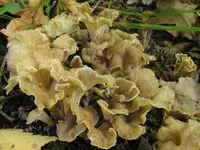
blackening chanterelle
Cantharellus melanoxeros
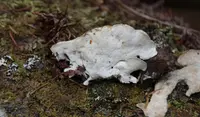
Bitter Bracket
Amaropostia stiptica
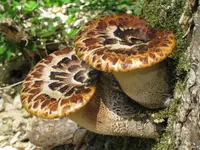
Dryad's Saddle
Cerioporus squamosus
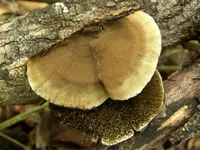
Cerrena hydnoides
Cerrena hydnoides
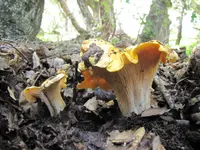
California Golden Chanterelle
Cantharellus californicus
Botryobasidium aureum
Botryobasidium aureum
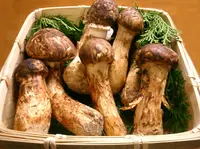
Matsutake
Tricholoma matsutake
Pinecone Amanita
Amanita magniverrucata