


Use clean hardwood
For reliable fruiting, inoculate only fresh, disease-free hardwood pieces and avoid softwood or decaying material that already hosts other fungi, since competitors will quickly outgrow Crepidotus crocophyllus.

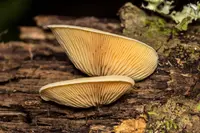
Saffron Crep, Crepidotus crocophyllus, is a small saprophytic fungus that grows on decaying wood rather than in pots or garden beds. It is recognized by its tiny, fan-shaped, saffron to orange-brown caps that form overlapping clusters on logs, stumps, and fallen branches.
This species is native to temperate forests and woodlands, often appearing during moist, mild weather. It plays an ecological role in breaking down dead wood, so it is more of a woodland curiosity than a cultivated species.
Because it requires very specific decomposing wood and humidity conditions, it is not considered practical to care for Saffron Crep in a typical home or garden setting.

Care Difficulty
Hard Care

Light Preference
Shade

Water Requirements
Keep Soil Moist

Temperature Preference
Cool Climate

Hardiness Zone
Unknown

Soil Texture
Organic-rich, Peaty

Soil pH
Strongly acidic (4.5–5.5)

Soil Drainage
Waterlogged tolerant

Fertilization
Minimal (feed rarely)
Scan your plant to receive care tips personalized for your specific plant
Available on iOS and Android
This small saprophytic fungus prefers soft, indirect woodland light rather than strong, open sun.
This wood-inhabiting species depends on consistently moist, not waterlogged, substrate rather than precise watering schedules.
This fungus fruits best in cool to mild conditions and is sensitive to extreme heat and strong frost.
This wood-inhabiting fungus does not have specific indoor humidity demands but prefers consistently moist microhabitats outdoors.
In cultivation, this saprophytic fungus is grown on decaying wood or very loose, organic-rich substrate rather than typical garden soil.
This species is suitable for experimental container growing on wood-based substrate rather than standard potting soil.
This wood-decaying fungus grows on nutrient-rich dead wood and usually does not need supplemental fertilizer, even when monitored as Saffron Crep in culture.
Crepidotus crocophyllus is not managed by pruning because it is a short-lived saprophytic fungus, not a woody or leafy plant.
When cultivated for observation, this fungus is managed by renewing its substrate rather than traditional repotting.
Propagation of Crepidotus crocophyllus is mainly done by transferring mycelium rather than using typical houseplant techniques.
Outdoor populations require no winter care, as this fungus appears opportunistically on suitable dead wood and then disappears.

Plant Health Check
Not sure what's wrong with your plant? Check your plant's health inside the app.
Mature fruiting bodies develop strongly saffron- to orange-colored gills and spore-bearing surfaces, which are unusually bright compared with the pale caps and help distinguish this species from similar Crepidotus fungi in the field.
The fungus forms small, sessile, fan- to shell-shaped caps that attach directly to the substrate without a stem, typically only a few millimeters to about 1 cm across, reflecting a growth form adapted to life on dead wood surfaces.
This saprotrophic fungus is most often recorded on decaying hardwood twigs and branches, especially in temperate broadleaf forests, where it contributes to the breakdown of lignocellulosic material and nutrient recycling.
This fungus is not considered edible and should not be collected for food. Identification is difficult, and small brown saprophytic mushrooms are easily confused with toxic species. For safety, treat it as non-edible and avoid consumption.
Keep your plants happy and healthy with plant identification, disease detection, and easy care guidance.

Eastern Black Trumpet
Craterellus fallax
Panaeolus antillarum
Panaeolus antillarum
Orange peel fungus
Aleuria aurantia
roundspored oysterling
Crepidotus cesatii
Northern Tooth
Climacodon septentrionalis
cinnabar oysterling
Crepidotus cinnabarinus
ghost fungus
Omphalotus nidiformis
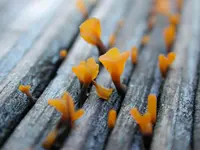
Fan-shaped Jelly Fungus
Dacryopinax spathularia