Use Decaying Wood
Establish the fungus on well-decayed, non-treated softwood boards or wood chips, as these provide a stable food source and reduce the need for frequent substrate replacement.

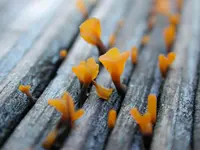
Fan-shaped jelly fungus, Dacryopinax spathularia, is a small jelly-like fungus rather than a typical leafy plant. It forms bright orange to yellow, spoon- or fan-shaped fruiting bodies that grow in clusters.
This species commonly appears on decaying wood, especially old boards, rails, or other processed timber in warm, humid climates. It often shows up after rains and can persist for long periods in damp conditions.
Because it is a saprophyte, meaning it feeds on dead organic material, it does not behave like a houseplant and is not easy to manage in pots. Anyone wanting to learn how to care for Fan-shaped Jelly Fungus should focus on providing consistently moist, shaded, wood-rich environments rather than regular soil-based culture.

Care Difficulty
Hard Care

Light Preference
Partial Shade

Water Requirements
Keep Soil Moist

Temperature Preference
Tropical / Frost Sensitive

Hardiness Zone
Unknown

Soil Texture
Loamy, Peaty, Organic-rich

Soil pH
Acidic (5.5–6.5)

Soil Drainage
Moist but well-drained

Fertilization
Minimal (feed rarely)
Scan your plant to receive care tips personalized for your specific plant
Available on iOS and Android
This wood-decaying fungus prefers soft, indirect light that mimics a shaded forest floor.
This fungus depends on steady substrate moisture rather than direct watering of the fruiting bodies.
This species favors warm, humid conditions typical of subtropical to tropical climates.
This wood-inhabiting jelly fungus prefers consistently moist air but tolerates moderate variation.
This species grows on decaying wood rather than in mineral soil, so the substrate must mimic rotting timber.
This jelly fungus can be grown in containers if the pot is treated as a holder for a moist, wood-based substrate block rather than typical potting soil.
This wood-decaying fungus usually grows on nutrient-rich dead wood and needs little added fertilizer in cultivation.
Dacryopinax spathularia does not need conventional pruning, but spent fruiting bodies can be tidied if desired.
This fungus is usually grown on fixed wood substrates, so transplanting focuses on renewing or moving colonized material rather than conventional repotting.
Propagation of this fungus is specialized and not usually attempted by casual growers, as it depends on spores and sterile culture methods.
This wood-inhabiting fungus is fairly cold tolerant on natural logs and usually needs little dedicated winter care outdoors in mild climates.

Plant Health Check
Not sure what's wrong with your plant? Check your plant's health inside the app.
This fungus produces thin, spoon- or fan-shaped, bright orange to yellow fruiting bodies with a gelatinous, rubbery texture that rehydrates after drying. The jelly-like tissue is composed of highly hydrated hyphae, which allows the fruiting body to swell and shrink with moisture changes.
It is a saprotrophic fungus that colonizes dead or very decayed wood, particularly coniferous timber, contributing to nutrient recycling in forest and urban environments. On sawn lumber and outdoor wooden structures, it often appears as vivid patches on already weathered, structurally weakened wood.
This species commonly fruits in warm, humid conditions across tropical and subtropical regions and can tolerate relatively high temperatures compared to many temperate wood-decay fungi. Its ability to persist and fruit on exposed timber in hot, rainy seasons has made it a recognizable component of outdoor wooden structures in these climates.

This species has been used as a natural yellow food colorant and texture component in some East and Southeast Asian products, such as jellies and traditional desserts, because its fruiting bodies remain firm and elastic after cooking.
This species is considered edible in several Asian countries and is sometimes used in soups or desserts for texture rather than flavor. Only consume specimens from clean, uncontaminated substrates and avoid look-alike fungi that are not confidently identified.
Keep your plants happy and healthy with plant identification, disease detection, and easy care guidance.