Use decaying bark
Mount the moss on well-rotted conifer or hardwood bark rather than fresh wood, as this mimics its natural habitat and provides a stable, moisture-retentive surface for long-term colony growth.

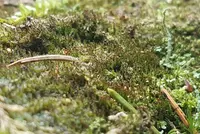
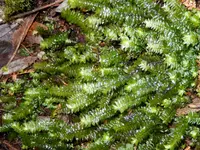
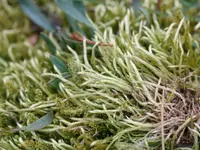
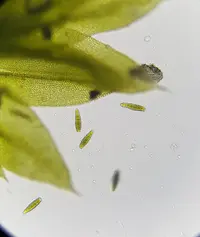
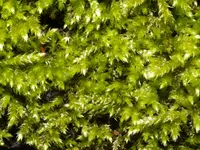
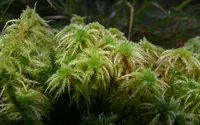
Heller's notchwort (Crossocalyx hellerianus) is a tiny leafy liverwort, a non-vascular plant related to mosses. It forms thin, flat green mats that hug rough bark or decaying wood. Leaves are overlapping, finely notched, and often tinged with brown, giving a delicate, textured look at close range.
This species occurs mainly in cool, humid forests of the Northern Hemisphere, especially on old conifer logs and shaded rock. It favors stable moisture, clean air, and low light, which makes it more demanding than typical houseplants. Those conditions explain why it can be challenging to care for Heller's Notchwort outside a terrarium or naturally damp, shaded outdoor setting.

Care Difficulty
Hard Care

Light Preference
Shade

Water Requirements
Keep Soil Moist

Temperature Preference
Cool Climate

Hardiness Zone
4–8

Soil Texture
Rocky, Organic-rich

Soil pH
Strongly acidic (4.5–5.5)

Soil Drainage
Moist but well-drained

Fertilization
Minimal (feed rarely)
Scan your plant to receive care tips personalized for your specific plant
Available on iOS and Android
This small liverwort prefers cool, shaded forest conditions with very limited direct sun exposure.
This bryophyte requires consistently moist conditions and does not tolerate drying out.
This species is adapted to cool, moist woodland climates and is sensitive to temperature extremes.
This moss-like liverwort needs consistently high humidity to persist in cultivation.
This species naturally grows on decaying conifer wood, so it needs an airy, moisture-retentive, organic substrate.
This species can be grown in shallow containers, especially closed or semi-closed terrarium setups.
This tiny epiphytic liverwort usually receives enough nutrients from decaying wood and trapped dust, so fertilization is rarely necessary for Heller's Notchwort.
Pruning needs for Crossocalyx hellerianus are minimal and mainly hygienic.
This species is usually established on rotting logs or bark, so care focuses on careful transplanting rather than frequent repotting.
Propagation of Crossocalyx hellerianus is usually done vegetatively by moving small colonized fragments rather than from spores.
This cool-temperate liverwort is quite cold hardy and usually needs little dedicated winter care outdoors.

Plant Health Check
Not sure what's wrong with your plant? Check your plant's health inside the app.
This tiny liverwort is strongly associated with old-growth conifer and mixed forests, where it grows mainly on very decayed logs in cool, humid, and shaded conditions.
It almost always colonizes highly decomposed, crumbly wood in the final stages of decay, often on spruce or fir logs that have lost most of their original structure.
The species has a boreal and temperate distribution across parts of Europe, Asia, and North America, and is often used as an indicator species in surveys of long-continuity forest habitats.

In several European countries, this liverwort is included on regional Red Lists and used as a bioindicator, because its presence can signal forests with long ecological continuity and relatively low recent disturbance.
This species performs best outdoors in cool, humid, shaded woodland conditions, usually on decaying conifer logs or shaded rocks. It is difficult to maintain indoors because stable moisture, high humidity, and strong air movement are hard to reproduce in homes.
Keep your plants happy and healthy with plant identification, disease detection, and easy care guidance.