Use rotting twigs
Place small, fully rotted hardwood twigs or bark chips just under the leaf-litter surface to provide the lignin-rich substrate these fungi need to fruit repeatedly in the same spot.

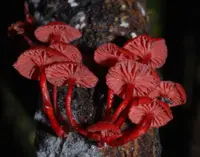
Ruby bonnet, Cruentomycena viscidocruenta, is a small woodland mushroom, not a typical houseplant. It produces tiny, vivid red caps on thin, fragile stems. These fruiting bodies often appear in moist leaf litter or mossy forest floors, especially in temperate regions of Australia and nearby areas.
The species prefers consistently damp, shaded habitats rich in decaying organic matter. It relies on natural forest conditions and complex fungal–soil relationships, which makes it difficult to cultivate indoors or in gardens. Most people admire it in situ rather than attempting to care for ruby bonnet in a home setting.

Care Difficulty
Hard Care

Light Preference
Shade

Water Requirements
Keep Soil Moist

Temperature Preference
Cool Climate

Hardiness Zone
Unknown

Soil Texture
Loamy, Peaty, Organic-rich

Soil pH
Acidic (5.5–6.5)

Soil Drainage
Moist but well-drained

Fertilization
Minimal (feed rarely)
Scan your plant to receive care tips personalized for your specific plant
Available on iOS and Android
This small woodland fungus prefers cool, shaded sites with brief gentle sun exposure.
This fungus needs consistently moist, not waterlogged, substrate to form reliable fruiting bodies.
This species fruits best in mild, cool conditions and declines in prolonged heat or hard frost.
This woodland fungus prefers consistently moist, humid air similar to damp forest conditions.
This species fruits best in loose, consistently damp, organic-rich substrate rather than typical potting soil.
This delicate fungus is only moderately suitable for container growing and does best in controlled, terrarium-style setups.
This small woodland fungus, often called ruby bonnet, does not need fertilization when grown in suitable, organically rich substrate.
Pruning is not applicable for Cruentomycena viscidocruenta, as it is a short-lived woodland mushroom that completes its life cycle without structural maintenance.
Cruentomycena viscidocruenta is not suited to traditional repotting and is best left undisturbed in outdoor woodland-style beds.
Propagation of Cruentomycena viscidocruenta is specialized and not typically attempted by home growers.
This woodland fungus is naturally cold hardy in suitable climates and needs no dedicated winter care from home gardeners.

Plant Health Check
Not sure what's wrong with your plant? Check your plant's health inside the app.
This small fungus is easily recognized by its vivid, almost lacquered crimson cap and matching red stipe, a coloration caused by intensely pigmented compounds concentrated in the cap cuticle and surface slime layer.
The cap is distinctly viscid to glutinous when moist, meaning it is coated in a sticky slime layer that helps retain water and may protect the delicate tissues from desiccation in exposed forest habitats.
It occurs mainly in wet sclerophyll forests and rainforests of eastern Australia and New Zealand, where it fruits on decaying leaf litter and small woody debris, contributing to nutrient recycling in cool, damp microhabitats.

Despite its intense blood-red coloration, this species produces white spores, which helps mycologists distinguish it from some superficially similar red-capped fungi that have differently colored spore prints.
Yes, this fungus develops from microscopic spores rather than traditional seeds. In nature, spores disperse on air currents and germinate in consistently moist, decaying plant material, especially wet leaf litter and rotting wood in cool, shaded forests.
Keep your plants happy and healthy with plant identification, disease detection, and easy care guidance.