Site hygiene
Remove and discard spent fruiting bodies and any soft, decaying material quickly to reduce fungal disease carryover and discourage fungus gnat buildup in future flushes.

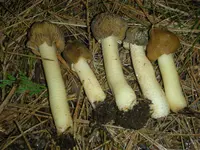
Conic morel, Verpa conica, is a small spring-fruiting fungus known for its slender, pale stem and bell-shaped cap that hangs loosely like a thimble. It is not a true morel but is often found in similar habitats.
This species usually appears in moist woodland areas, riverbanks, and mixed forests across temperate regions of North America and Europe. It typically grows singly or in small groups on soil rich in decaying organic matter.
Conic morel is considered challenging to cultivate because it depends on complex relationships with soil and surrounding plants. Most guides focus on how to care for conic morel in terms of habitat conservation rather than indoor or garden culture.

Care Difficulty
Moderate Care

Light Preference
Partial Shade

Water Requirements
Keep Soil Moist

Temperature Preference
Cool Climate

Hardiness Zone
4–8

Soil Texture
Loamy, Silty, Organic-rich

Soil pH
Acidic (5.5–6.5), Slightly acidic (6.5–7.0)

Soil Drainage
Moist but well-drained

Fertilization
Minimal (feed rarely)
Scan your plant to receive care tips personalized for your specific plant
Available on iOS and Android
This spring-fruiting fungus prefers cool, gentle light typical of open woodland edges.
This fungus depends on consistently moist but not waterlogged soil in its woodland habitat.
This species thrives in cool to mild spring temperatures that mimic natural forest conditions.
Humidity has only a minor influence on Verpa conica performance compared with moisture in the substrate.
Verpa conica needs consistently moist, loose, organic-rich substrate that mimics a forest floor.
This species is not well suited to long-term container growing, as it prefers complex, living soil in the ground.
This wild fungus is adapted to low-nutrient forest soils and usually does not need targeted fertilization when caring for conic morel in garden settings.
Verpa conica does not require active pruning because its fruiting bodies are short-lived and seasonal.
This species is typically foraged in place rather than grown in containers, so handling focuses on minimal disturbance of natural colonies.
Practical home propagation of Verpa conica is unreliable, as it depends on complex soil fungi relationships and suitable forest conditions.
This fungus overwinters naturally in the soil as mycelium and needs no special winter care in suitable climates.

Plant Health Check
Not sure what's wrong with your plant? Check your plant's health inside the app.
This species usually appears very early in spring, often before true morels, emerging soon after snowmelt in cool, moist hardwood forests and along river floodplains.
Its cap hangs loosely and is attached only at the very top of the stem, forming a skirt-like structure, which helps distinguish it from true morels whose caps are attached along the stem.
Unlike true morels with honeycomb-like pits and ridges, this fungus has a smoother, irregularly wrinkled or folded cap surface, which is a key identification feature for Verpa conica care instructions.

The genus Verpa is considered closely related to true morels (Morchella), and molecular studies place Verpa conica within the same broader family (Morchellaceae), highlighting an evolutionary link despite their clear morphological differences.
This species is considered edible by many foragers but is often described as of lower culinary quality than true morels. It must always be thoroughly cooked, and correct identification is essential to avoid confusion with toxic look-alikes.
Keep your plants happy and healthy with plant identification, disease detection, and easy care guidance.