Use hardwood blocks
For reliable fruiting, colonize dense, untreated hardwood blocks (such as oak or beech) rather than loose chips, which keeps moisture more stable and supports thicker, longer-lasting brackets.

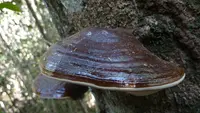
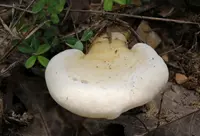
Southern bracket, Ganoderma australe, is a perennial wood-decay fungus rather than a typical leafy plant. It forms large, hard, shelf-like brackets on trunks, stumps, or large branches.
This species is common on broadleaf trees in parks, woodlands, and urban landscapes across temperate regions. Its slow, woody growth and specific need for decaying or weakened wood make it unsuitable for standard pot culture.
Because it relies on dead or stressed trees, it is not easy to manage as a decorative house specimen. Those wishing to learn how to care for southern bracket typically focus on understanding its role in wood decomposition and tree health, rather than traditional cultivation.

Care Difficulty
Moderate Care

Light Preference
Shade

Water Requirements
Keep Soil Moist

Temperature Preference
Cool Climate

Hardiness Zone
Unknown

Soil Texture
Loamy, Organic-rich, Peaty

Soil pH
Acidic (5.5–6.5), Slightly acidic (6.5–7.0)

Soil Drainage
Moist but well-drained

Fertilization
Minimal (feed rarely)
Scan your plant to receive care tips personalized for your specific plant
Available on iOS and Android
This wood-decaying bracket fungus prefers low to moderate natural light in wooded or shaded habitats.
This fungus relies on consistently moist, not saturated, wood rather than direct watering of the fruiting body.
This perennial bracket fungus is adapted to temperate climates with moderate seasonal shifts.
This wood-decaying fungus has no meaningful humidity requirements for cultivated care and does not respond to typical indoor humidity adjustments.
In gardens or managed woodland, Ganoderma australe develops on woody material rather than in conventional soil, so preparation focuses on the substrate around and beneath host wood.
This species is not suitable for typical container growing because it naturally colonizes large pieces of wood and tree bases rather than confined potting volumes.
Ganoderma australe naturally colonizes wood and usually does not benefit from direct fertilization.
Pruning Ganoderma australe focuses on safe removal rather than shaping or encouraging growth.
This wood-decay fungus is not suited to normal repotting, so management focuses on handling colonized logs or stumps.
Intentional propagation of Ganoderma australe is specialist work and not recommended for routine garden projects.
Once established in wood, this fungus is naturally cold hardy and requires no special winter care.

Plant Health Check
Not sure what's wrong with your plant? Check your plant's health inside the app.
Mature fruiting bodies of this species develop a very thick, hard, dark brown to black crust on the upper surface, much more robust than many similar bracket fungi, which helps protect the pore layer from mechanical damage.
The basidiocarps of this fungus are perennial and can persist and continue to add new growth layers for many years, often forming large, hoof‑like shelves that remain attached to the same tree trunk or stump.
Fresh growth typically appears as a distinct white or cream margin around the bracket edge, and this actively growing zone helps mycologists distinguish it in the field from some related, more uniformly colored species.

Ganoderma australe is one of the main agents of white rot in broadleaf trees in Europe and other temperate regions, efficiently breaking down both lignin and cellulose and thereby playing a key role in hollowing out aging trunks that later serve as habitat for insects, bats, and cavity‑nesting birds.
This wood-decay fungus grows slowly but steadily, expanding its bracket over many years. Individual brackets can reach 30–60 cm across and many centimeters thick, forming heavy, shelf-like layers on infected trunks or stumps.
Keep your plants happy and healthy with plant identification, disease detection, and easy care guidance.