Use clean substrate
Prepare the fruiting substrate from well-composted hardwood sawdust or chips that have been heat-treated or pasteurized to reduce competing fungi and bacteria before inoculation.

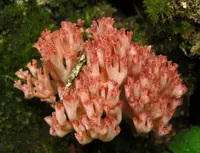
Ramaria botrytis, often called rosso coral or clustered coral fungus, is a coral-like mushroom rather than a leafy plant. It forms dense, branching clusters that resemble underwater coral, usually in pale pink to creamy colors that deepen at the tips.
This species typically appears on soil in mixed or broadleaf woods, especially in temperate regions of Europe, Asia, and North America. It is considered a choice edible in some traditions, but reports of confusion with toxic coral fungi make identification critical.
Those who care for rosso coral in cultivation attempt to mimic cool, moist woodland conditions with rich organic matter. Its reliance on complex soil and fungal relationships makes it challenging for most home growers.

Care Difficulty
Hard Care

Light Preference
Partial Shade

Water Requirements
Keep Soil Moist

Temperature Preference
Cool Climate

Hardiness Zone
Unknown

Soil Texture
Loamy, Silty, Organic-rich

Soil pH
Acidic (5.5–6.5), Slightly acidic (6.5–7.0)

Soil Drainage
Moist but well-drained

Fertilization
Minimal (feed rarely)
Scan your plant to receive care tips personalized for your specific plant
Available on iOS and Android
Ramaria botrytis prefers cool, forest-like light conditions similar to its natural woodland habitat.
Watering for Ramaria botrytis focuses on consistently moist, not saturated, soil or substrate around the host trees.
This species prefers cool to mild conditions and fruits best when soil and air stay in a moderate temperature band.
Humidity is not a major controllable factor for Ramaria botrytis, which naturally fruits in moist forest habitats rather than indoor settings.
Ramaria botrytis needs a consistently moist, organic-rich forest floor substrate rather than conventional garden soil.
This species is generally unsuitable for long-term container growing, as it relies on complex mycorrhizal relationships with tree roots in natural soil.
Ramaria botrytis is usually not fertilized in home or woodland settings, since it relies on soil fungi and decaying organic matter.
Ramaria botrytis is not pruned like a typical garden plant; only minor cleanup of fruiting bodies is useful.
This fungus is rarely grown in pots; transplanting focuses on moving colonized substrate rather than the organism itself.
Ramaria botrytis propagation is specialized and mostly attempted by experienced growers or researchers.
This woodland fungus is generally cold hardy in its native range and needs little specific winter care.

Plant Health Check
Not sure what's wrong with your plant? Check your plant's health inside the app.
This species forms dense, coral-like clusters with short, thick branches that are pink to reddish at the tips when young and gradually turn yellowish or tan as they age.
It is an ectomycorrhizal fungus, forming mutualistic associations with the roots of trees such as beech and other broadleaf species, where it exchanges mineral nutrients for sugars produced by the host.
Young specimens are considered a choice edible mushroom in parts of Europe and East Asia, but older fruiting bodies quickly become tough and can cause digestive upset, so correct age selection is important.

In some European regions, this fungus is considered locally uncommon and is monitored or given conservation attention because its ectomycorrhizal habitats are sensitive to changes in forest management and soil disturbance.
Growth is relatively slow. Fruiting bodies usually reach full size in 1–3 weeks once conditions are right, but suitable mycelium in the soil may take several seasons to establish before regular flushes appear.
Keep your plants happy and healthy with plant identification, disease detection, and easy care guidance.