Rot-safe collection
Always collect substrate and mycelium from areas with excellent drainage and no standing water, since saturated micro-sites dramatically increase the risk of lethal rot in Gyromitra infula beds.

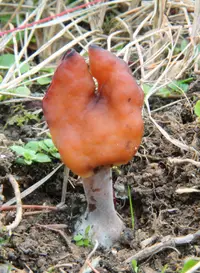
The saddle-shaped false morel, Gyromitra infula, is a fungus, not a traditional houseplant. It produces thin, saddle-like caps in brown to reddish tones on slender stems. This mushroom typically appears on rotting wood or forest debris, especially in coniferous and mixed forests of North America, Europe, and parts of Asia.
It is not suited to standard indoor growing and is generally difficult to cultivate on purpose. Most people encounter it in the wild rather than trying to care for Saddle-shaped False Morel at home. It favors cool conditions, moist but well-drained forest substrates, and undisturbed natural habitats.

Care Difficulty
Hard Care

Light Preference
Partial Shade

Water Requirements
Keep Soil Moist

Temperature Preference
Cool Climate

Hardiness Zone
Unknown

Soil Texture
Loamy, Organic-rich, Peaty

Soil pH
Acidic (5.5–6.5), Slightly acidic (6.5–7.0)

Soil Drainage
Moist but well-drained

Fertilization
Minimal (feed rarely)
Scan your plant to receive care tips personalized for your specific plant
Available on iOS and Android
This fungus prefers low, forest-floor light rather than direct sun exposure.
Moist, well-drained forest soil is essential for stable fruiting conditions.
This species favors cool to mild conditions typical of late summer to autumn forests.
This fungus requires very high humidity to fruit reliably in cultivation attempts.
Gyromitra infula fruits on very decayed wood and organic debris rather than true soil, so the substrate must mimic rotting forest material.
This species is not well suited to conventional container growing and is rarely managed successfully in pots.
Gyromitra infula is a wild, mycorrhizal fungus that does not benefit from conventional fertilization and should not be fed like a garden plant.
Gyromitra infula does not need horticultural pruning, but fruiting bodies can be managed for safety and site hygiene.
This fungus is not suited to conventional repotting and is best left in its natural soil and woody debris habitat rather than moved.
Intentional propagation of Gyromitra infula is not recommended for home growers due to toxicity and complex ecological needs.
This wild fungus is naturally cold hardy in its native range and needs no deliberate winter care from gardeners.

Plant Health Check
Not sure what's wrong with your plant? Check your plant's health inside the app.
This species typically fruits in late summer to autumn, forming saddle- or ear-shaped caps rather than the brain-like forms seen in several other false morels, and the cap underside bears smooth structural folds instead of true gills.
The fungus usually grows on well-decayed conifer wood, old buried stumps, or woody debris, acting as a saprobe that helps break down lignified plant material and recycle nutrients in montane and boreal forest ecosystems.
Its tissues contain gyromitrin, a volatile toxin that can convert to monomethylhydrazine in the body, causing severe liver, kidney, and nervous system damage, and it is considered poisonous even though some related species are traditionally eaten after processing.

Gyromitra infula has historically been confused with several similar false morels, and modern mycologists rely on a combination of microscopic features, such as spore shape and surface ornamentation, and habitat on rotting conifer wood to separate it reliably from close relatives.
This fungus is considered poisonous and should never be eaten, even if cooked or dried. It contains unstable toxins that can cause severe liver and nervous system damage. For safety, treat all similar false morels as inedible.
Keep your plants happy and healthy with plant identification, disease detection, and easy care guidance.