Use fresh conifer
Install freshly cut pine or Douglas fir logs within 1–2 weeks of felling, as this fungus colonizes best on recently dead conifer wood with intact bark and moderate moisture content.

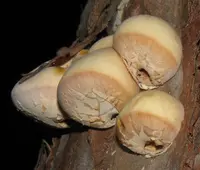
The veiled polypore, Cryptoporus volvatus, is a bracket fungus that grows on dead or dying conifers, especially pines. It forms rounded, pale to tan fruiting bodies with a distinct veil-like covering over the spore chamber.
This fungus is most often found in North America on fire-damaged or weakened trees, playing a role in wood decay and nutrient recycling. It is not a typical houseplant, and attempts to grow it require access to suitable conifer wood and stable, moist conditions.
Because it depends on very specific wood and environmental conditions, it is considered challenging for hobbyists, and information on how to care for Veiled Polypore at home is limited.

Care Difficulty
Hard Care

Light Preference
Partial Shade

Water Requirements
Keep Soil Moist

Temperature Preference
Cool Climate

Hardiness Zone
Unknown

Soil Texture
Loamy, Silty, Organic-rich

Soil pH
Acidic (5.5–6.5)

Soil Drainage
Moist but well-drained

Fertilization
Minimal (feed rarely)
Scan your plant to receive care tips personalized for your specific plant
Available on iOS and Android
This wood-decay fungus prefers low to moderate light, similar to a shaded forest setting.
Moist, not saturated, conditions around the wood substrate are essential for stable fruiting.
This species develops best in cool to mild conditions typical of temperate forests.
This wood-decaying fungus is not a typical houseplant and rarely needs active humidity management when observed on logs outdoors.
This species naturally fruits on decaying conifer wood rather than in conventional soil, so focus on recreating a woody, decomposing substrate.
This fungus is only marginally suitable for container culture and is best grown on inoculated wood kept in a stable tub or tray.
Cryptoporus volvatus is a wood-decaying fungus that usually gains all needed nutrients from its host and surrounding organic matter, so fertilization is not required for healthy development.
Pruning is not a standard practice for Cryptoporus volvatus because it is a bracket fungus forming directly on wood rather than a leafy plant.
Transplanting Cryptoporus volvatus is rarely successful because the fungus depends on colonized wood rather than a typical root system.
Propagation of Cryptoporus volvatus is specialized and usually left to natural spore dispersal rather than deliberate home cultivation.
This fungus is naturally cold hardy in its native range and typically needs no special winter care when growing on outdoor wood.

Plant Health Check
Not sure what's wrong with your plant? Check your plant's health inside the app.
This fungus forms hollow, ball-like fruiting bodies with a small pore that shelters bark beetles, which use the interior as a breeding chamber and gain protection while they feed and develop.
Instead of relying mainly on wind, this species produces a powdery spore mass inside its closed structure, and spores attach to visiting bark beetles that carry them to new weakened or recently killed conifer hosts.
It commonly appears on fire-killed or recently dead conifers in western North America, contributing to the early stages of wood decay and nutrient recycling in post-disturbance forests.

Genetic and morphological studies indicate that this species is closely related to boletes, even though it looks like a gilled mushroom or puffball, highlighting a case where evolutionary relationships differ strongly from superficial appearance.
This fungus is not considered edible. The texture is tough and corky, and there are no established culinary uses. Some sources mention traditional medicinal interest, but it should not be consumed without professional identification and expert guidance.
Keep your plants happy and healthy with plant identification, disease detection, and easy care guidance.